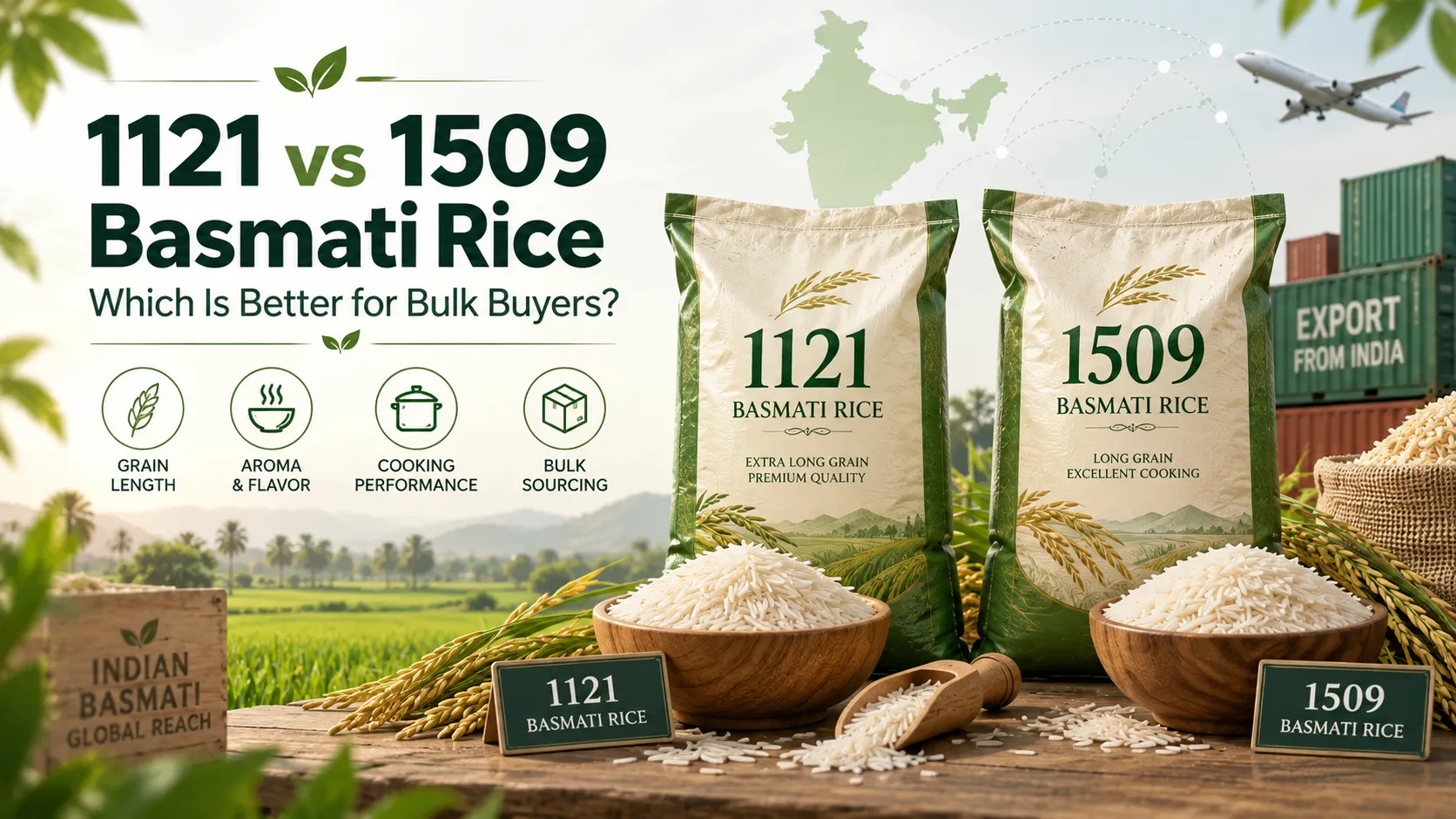
When sourcing Basmati rice in bulk, two names appear frequently: 1121 Basmati rice and 1509 Basmati rice. Both are widely traded Indian Basmati varieties known for long grains, aroma and good cooking performance, but they are not identical.
For bulk buyers, the simple answer is this: 1121 Basmati is generally the better choice for premium positioning and exceptional grain elongation, while 1509 Basmati is a practical option for buyers seeking a balance between Basmati quality, volume and competitive sourcing.
However, choosing between them should involve more than comparing the variety name. Processing type, ageing, moisture, broken percentage, grain uniformity and the actual shipment specification matter just as much.
What Is 1121 Basmati Rice?
1121 Basmati rice, also known as Pusa Basmati 1121, is one of India’s well-known extra-long-grain Basmati varieties.
It is especially valued for its slender appearance and excellent elongation after cooking. This makes 1121 extra long grain Basmati rice suitable for premium retail packs, restaurants, hotels, catering businesses and dishes where rice presentation is important.
According to the ICAR Basmati Rice Varieties resource, Pusa Basmati 1121 is recognised among India’s important Basmati varieties, while IARI describes it as having extra-long slender, aromatic grains and exceptionally high cooked-kernel elongation.
For buyers researching India’s larger rice market, our Rice Export from India Guide explains sourcing, export considerations and the role India plays in international rice trade.
What Is 1509 Basmati Rice?
1509 Basmati rice, or Pusa Basmati 1509, is another important Indian Basmati variety.
It was developed as an earlier-maturing variety. ICAR notes that Pusa Basmati 1509 matures earlier than Pusa Basmati 1121 and has agronomic advantages such as reduced irrigation requirements.
From a commercial buyer’s perspective, 1509 rice offers attractive long-grain characteristics and is often considered when sourcing for wholesale distribution, food service or markets where buyers need a strong balance between appearance, cooking quality and purchasing cost.
Both 1121 and 1509 can also be offered in different processing forms such as Steam, Sella and Golden Sella. Buyers should therefore avoid comparing an 1121 Steam sample directly with a 1509 Golden Sella sample and assuming that every difference comes from the variety itself.
1121 vs 1509 Basmati Rice: Quick Comparison
| Feature | 1121 Basmati Rice | 1509 Basmati Rice |
|---|---|---|
| Grain type | Extra-long and slender | Long, slender grain |
| Cooked elongation | Exceptional | Good |
| Market positioning | Premium | Premium/value balance |
| Best suited for | Premium retail, HORECA, biryani, high-end catering | Wholesale, food service, retail and volume buying |
| Crop maturity | Longer | Earlier |
| Processing options | Raw, Steam, Sella, Golden Sella | Raw, Steam, Sella, Golden Sella |
| Buyer priority | Presentation and elongation | Value, quality and volume |
Specifications can vary between crops, mills and lots, so bulk buyers should always approve an actual sample and written specification before placing an order.
Grain Length and Cooking Performance
Grain appearance is one of the biggest reasons buyers compare Basmati 1121 with 1509 Basmati.
1121 is particularly famous for its long, elegant appearance after cooking. For restaurants, premium packaged-rice brands and catering businesses, this elongation can improve the visual presentation of biryani, pulao and similar rice dishes.
1509 also provides attractive long grains, but it is generally selected when buyers want reliable Basmati characteristics without making maximum grain elongation their only priority.
In either case, a professional rice supplier should provide the specification for the exact lot being offered rather than relying only on the variety name.
Price: Is 1509 Cheaper Than 1121?
There is no permanent price difference that applies to every shipment.
Rice prices change according to crop availability, ageing, processing method, broken percentage, moisture, quality grade, order volume, packaging and market conditions.
1121 is commonly positioned in the premium segment because of its exceptional elongation and strong buyer recognition. 1509 rice can provide an attractive alternative for commercial buyers who want Basmati quality while keeping procurement costs under control.
A wholesale rice dealer or importer should therefore compare offers using the same processing type and similar specifications rather than choosing purely on price per metric tonne.
Steam, Sella or Golden Sella: Variety Is Only Half the Decision
A common mistake is assuming that “1121” or “1509” is a complete purchase specification.
It is not.
A buyer may purchase:
- 1121 Steam Basmati
- 1121 Golden Sella Basmati
- 1509 Steam Basmati
- 1509 Sella Basmati
Processing affects colour, texture, cooking behaviour and market suitability.
Packaging is equally important when importing large quantities. Buyers can review our Rice Export Packaging Guide for information about packaging options, bag sizes and export considerations.
What Should Bulk Buyers Check Before Ordering?
Whether working with Basmati rice suppliers in India, Basmati rice manufacturers or an international rice seller, request a clear product specification before confirming the order.
Check:
- Variety: 1121 or 1509
- Processing: Raw, Steam, Sella or Golden Sella
- Grain size and uniformity
- Broken rice percentage
- Moisture level
- Foreign matter
- Crop year and ageing
- Cooking result
- Packaging requirement
- Quantity and destination
- Required certificates and export documentation
Businesses sourcing food products internationally should also understand India’s export documentation requirements. Our guide to APEDA, FSSAI and IEC registration for food exports provides useful background.
1121 or 1509: Which Is Better for Bulk Buyers?
There is no single winner for every market.
Choose 1121 Basmati rice when your customers value premium presentation, exceptional cooked-grain elongation and a high-end Basmati positioning.
Choose 1509 Basmati rice when you need long-grain Basmati for larger volumes and want to balance product quality with commercial pricing.
Many importers and distributors can also benefit from carrying both varieties: 1121 for premium customers and 1509 for value-focused or higher-volume segments.
If your business also handles alternative rice categories, understanding the non-Basmati rice export market from India can help you build a wider sourcing portfolio.
Conclusion
The 1121 vs 1509 Basmati rice decision ultimately depends on your customers, target price, processing preference and required product specification.
1121 stands out for premium appearance and exceptional elongation, while 1509 offers an appealing balance of Basmati characteristics and commercial efficiency.
Instead of selecting a rice supplier only by price, bulk buyers should compare representative samples, cooking performance, written specifications, documentation and packaging before confirming an order. Working with experienced Basmati rice suppliers in India can make it easier to source a product that matches the exact needs of your retail, wholesale or HORECA market.
FAQ's
1121 is especially known for extra-long grains and exceptional elongation after cooking. 1509 is an earlier-maturing Basmati variety offering good long-grain characteristics and strong commercial value.
1121 is generally better suited to premium markets where grain presentation is important. 1509 can be better for volume buyers seeking a balance between quality and purchasing cost.
Yes. Its long, slender grains and strong elongation make 1121 a popular choice for biryani, pulao, catering and premium restaurant applications.
Yes. Distributors often choose different varieties for different customer segments, provided each lot meets the required quality, processing and packaging specifications.
Compare product samples, processing type, moisture, broken percentage, crop and ageing information, packaging, documentation, supply capacity and the final written specification before placing a bulk order.