
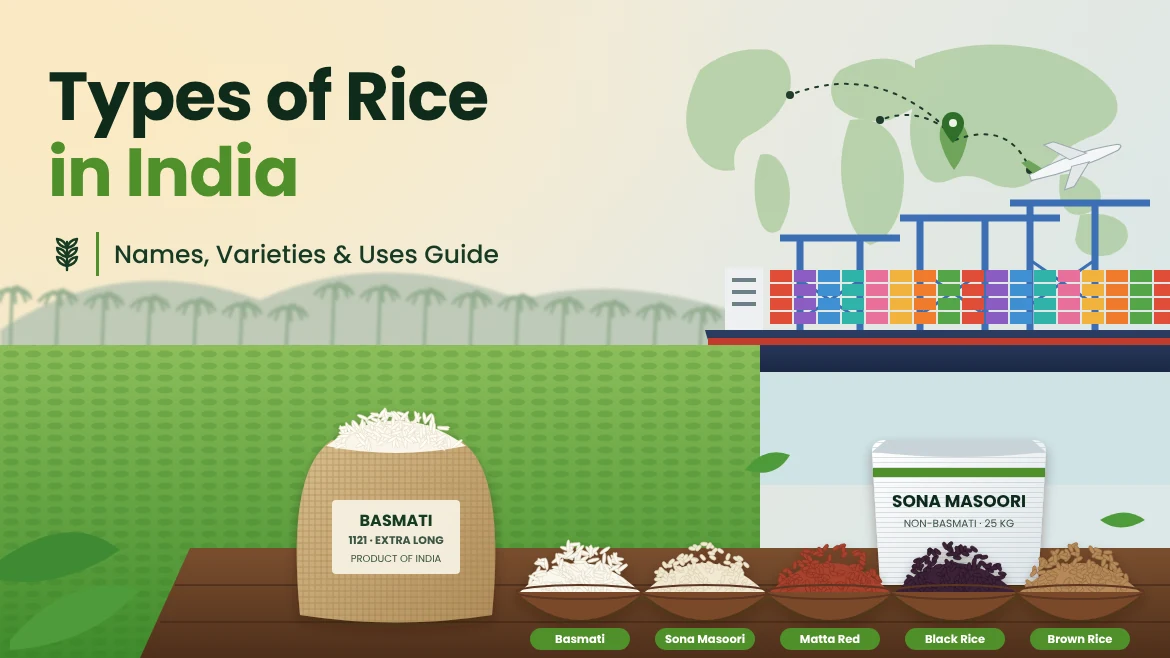
Ask for rice at any kirana store in India and the shopkeeper will ask you a question back: which one? Basmati for biryani, Sona Masoori for daily meals, Ponni for idli, Gobindobhog for payesh. The answer changes from one state to the next, sometimes from one district to the next.
That is because India grows more rice varieties than almost any other country. For a home cook, this is a nice problem. For a farmer, miller or trader, it decides who will buy your crop and at what price.
This guide covers the main types of rice in India, how they are grouped, a rice name list with regions and uses, and which varieties sell best in domestic and export markets.
How Many Types of Rice Are There in India?
There is no single number. Researchers count traditional varieties in the thousands, and new high-yield varieties are released by agricultural universities almost every year. So when people ask how many varieties of rice in India there are, the honest answer is “more than anyone can list in one place”.
What matters more is how the different types of rice are grouped. Buyers usually sort them in four ways:
- By grain length: long grain (basmati, IR64), medium grain (Sona Masoori, Ponni) and short grain (Gobindobhog, Kalanamak).
- By aroma: aromatic rices with a natural fragrance, and non-aromatic rices for everyday cooking.
- By colour: white, brown, red and black rice.
- By processing: raw, steam, parboiled and sella.
Most of the 10 types of rice you see on supermarket shelves fit into these groups. Once you know them, any rice name list becomes easy to read.
Basmati Rice Varieties
Basmati is India’s best-known rice and its biggest export earner. It is long, slender and aromatic, and the grain gets longer as it cooks. Basmati carries a Geographical Indication (GI) tag that covers seven north Indian states, including Punjab, Haryana, Himachal Pradesh, Uttarakhand, Delhi and parts of Uttar Pradesh and Jammu and Kashmir.
The main basmati varieties traded today are:
- 1121 Basmati: the extra-long grain that Gulf buyers love. It elongates more than any other variety.
- 1509 Basmati: a shorter-duration crop with good length, and usually priced a little lower than 1121.
- 1401 and Pusa Basmati 1: steady sellers with good aroma.
- Traditional Basmati: older varieties such as Basmati 370, with stronger aroma but lower yield.
If you are choosing between the two most traded varieties, our comparison of 1121 vs 1509 basmati rice explains how bulk buyers decide.
Popular Non-Basmati Rice Varieties
Non-basmati rice is what most Indians eat every day, and by volume it makes up most of India’s rice exports. Non-basmati rice exports go to Africa, Southeast Asia and the Gulf. These are the names you will hear most:
- Sona Masoori: a light, medium-grain rice from Andhra Pradesh, Telangana and Karnataka. It is the default daily rice in many South Indian homes.
- Ponni: Tamil Nadu’s favourite, used for meals as well as idli and dosa batter.
- IR64: a long-grain, non-aromatic variety grown widely across India and shipped in bulk, often as parboiled rice.
- Kolam: a small, soft grain popular in Maharashtra and Gujarat.
- Swarna: a high-yield variety common in eastern India.
Aromatic Short-Grain Regional Rices
These rices are small in grain but big in flavour. Most are grown in limited areas, and several have their own GI tags.
- Gobindobhog (West Bengal): a short, buttery, fragrant grain used for payesh, khichuri and temple offerings.
- Kalanamak (Uttar Pradesh): a black-husked aromatic rice from the Terai belt, often called the “Buddha rice”.
- Jeeraga Samba (Tamil Nadu): a tiny grain shaped like cumin seed, and the classic choice for South Indian biryani.
- Joha (Assam): a short-grain aromatic rice used in festive dishes and kheer.
Red, Brown and Black Rice
Coloured rice has moved from village kitchens to city health stores. Matta rice from Kerala is a red, parboiled rice with a nutty taste. Chak-hao from Manipur is a black, slightly sticky rice used for desserts. Himalayan red rice is grown in the hills of Uttarakhand and Himachal Pradesh.
Brown rice is not a separate variety. It is any rice with the bran layer left on, so you can have brown basmati or brown Sona Masoori.
Rice Name List in India
Here is a quick variety rice name list with the type, region and common use of each. Use it as a starting point. Every state has local names beyond these.
| Rice name | Type | Main growing region | Common use |
| 1121 Basmati | Extra-long grain, aromatic | Punjab, Haryana | Biryani, pulao, Gulf exports |
| 1509 Basmati | Long grain, aromatic | Punjab, Haryana, western UP | Biryani, export |
| Traditional Basmati | Long grain, strong aroma | Punjab, Haryana, J&K | Premium pulao |
| Sona Masoori | Medium grain, light | Andhra Pradesh, Telangana, Karnataka | Daily meals, South India |
| Ponni | Medium grain | Tamil Nadu | Daily meals, idli, dosa |
| IR64 | Long grain, non-aromatic | Many states | Daily meals, bulk export |
| Kolam | Short to medium grain | Maharashtra, Gujarat | Daily meals |
| Gobindobhog | Short grain, aromatic | West Bengal | Payesh, khichuri, bhog |
| Kalanamak | Short grain, aromatic | Eastern Uttar Pradesh | Plain rice, festive meals |
| Jeeraga Samba | Tiny grain, aromatic | Tamil Nadu | Biryani in South India |
| Joha | Short grain, aromatic | Assam | Festive dishes, kheer |
| Matta | Red, parboiled | Kerala | Kanji, Kerala meals |
| Chak-hao | Black, sticky | Manipur | Kheer, desserts |
Raw, Steam, Parboiled and Sella Rice: What the Labels Mean
The same paddy can become different rice depending on how it is processed. This is where many buyers and sellers get confused.
- Raw (white) rice: milled straight from dried paddy. It is soft and cooks fast.
- Steam rice: paddy is lightly steamed before milling. The grain becomes firmer and stays separate after cooking.
- Parboiled rice: paddy is soaked, steamed and dried before milling. It holds more nutrients and breaks less in milling.
- Sella rice: the trade name for parboiled basmati. Golden sella has a light yellow colour; white sella is lighter.
Best Rice Variety in India for Selling and Export
There is no single best rice variety in India. The best one is the one your buyer wants. A few patterns hold steady:
- Gulf buyers prefer 1121 basmati in sella and steam forms for biryani and mandi.
- South Indian and NRI buyers want Sona Masoori and Ponni.
- Bulk importers in Africa and Asia buy long-grain non-basmati like IR64, often parboiled.
- Health stores and premium retail buy red, black and GI-tagged aromatic rice in small packs.
For producers, timing matters as much as variety. Prices move with the harvest, so read our guide to seasonal food sourcing from India before you fix your selling plan. If you are a farmer group, our post on how FPOs can start exporting explains how to reach buyers directly.
Buyers looking for basmati rice suppliers in India or non-basmati rice exporters in India usually ask for the same things: clear variety, consistent grain length, low broken percentage and a lab report. Rice wholesale buyers will pay more for a supplier who can give the same quality every month.
Final Thoughts
Knowing the types of rice in India helps everyone in the chain, from the farmer choosing what to plant to the trader deciding what to stock. Basmati brings the premium, non-basmati brings the volume, and regional rices bring a loyal niche. Match the variety to the buyer and the selling becomes easier.
D&S International sources rice and grains from Indian producers and supplies buyers in the UAE, Saudi Arabia and beyond. If you grow or mill basmati or non-basmati rice and want a dependable buyer, connect with our team.
FAQ's
India has thousands of traditional rice varieties. In trade, they are grouped by grain length, aroma, colour and processing, such as basmati, non-basmati, red, black, parboiled and sella.
It depends on the use. Basmati 1121 is the most popular for biryani and exports, Sona Masoori for daily meals in South India, and Gobindobhog or Kalanamak for aromatic regional dishes.
Basmati is a long, aromatic rice grown in the GI-tagged regions of north India, and its grain gets longer when cooked. Non-basmati covers all other varieties, including Sona Masoori, Ponni and IR64.
Sella is parboiled basmati. The paddy is soaked and steamed before milling, which makes the grain firmer, less breakable and well suited to biryani.