A buyer in Dubai can’t walk into your cardamom store or your rice godown. Before they agree a price, before they place an order, they’ll ask for one thing: an export sample.
That parcel is your first real meeting with the buyer. A good one can lead to a container order. A careless one ends the conversation, often without any reply explaining why.
We deal with samples from growers, FPOs, aggregators and millers every week, and the same problems come up again and again. Too little product. Blurry photos. A pouch with no label. A lab report from two seasons ago. None of these are hard to fix.
This guide shows you how to send a sample that gives your product a fair chance, step by step.
Why the export sample matters so much
The sample shows the buyer what they’ll actually get. They’ll check it against your photos, your spec sheet and what you told them on the phone. If the sample looks better than the photos, you build trust. If it’s worse, you lose it, and it’s very hard to win back.
There’s a second reason. The buyer often compares your sample with samples from three or four other suppliers on the same day. In the end, the decision comes down to how the products look side by side on a table.
Before you send anything, agree these five things
Most sample problems start with a rushed phone call. Before you pack anything, get answers to these questions, ideally in writing on WhatsApp or email:
- Exact grade or specification. “Good cardamom” isn’t a specification. “7mm, green, litre weight 415 g” is. For cumin, ask whether they want Europe Quality or Singapore Quality. For rice, ask about variety, grain length and the broken % they’ll accept.
- How much they need. Some buyers test in a lab, some cook trial batches, some just look. Each needs a different quantity.
- Who pays for the courier. Many suppliers send the first sample free and ask the buyer to cover shipping for repeat samples. Say this clearly at the start.
- The deadline. If the buyer is deciding next week, a sample sent by slow post is wasted.
- What they will test. If you know they’ll test for pesticide residue or moisture, you can check your own lot first.
How much sample to send
There’s no fixed rule. The buyer’s request comes first. If they leave it to you, these amounts are normal in the trade:
| Product | Usual sample size | Notes |
| Green cardamom | 250 g to 500 g per grade | Send each grade separately. Don’t mix sizes in one pouch. |
| Cumin seeds | 500 g to 1 kg per quality | Enough for a purity check and a lab test |
| Rice | 1 kg to 2 kg per variety | Buyers often cook a trial batch |
| Pomegranate | 1 carton (about 3 kg to 5 kg) | Send it packed the way your commercial cartons will be |
Two rules matter more than the numbers.
First, take the sample from your real stock. Don’t hand-pick the best pods for the sample and ship ordinary ones in the container. Buyers compare every shipment with the approved sample. If the two don’t match, they can reject the shipment and claim against you.
Second, draw the sample properly. Take small amounts from several bags, from the top, middle and bottom, and mix them. This gives a fair picture of the whole lot.
Product photos that sell before the parcel arrives
Buyers usually ask for photos first and a physical sample later. Good photos save you money on samples that were never going to lead to an order.
You don’t need a studio. You need daylight and a bit of patience.
- Shoot in natural light, near a window or outdoors in shade. Direct sun makes green cardamom look yellow, and tube lights add a blue tint.
- Use a plain white or grey background. A sheet of paper works.
- Show scale. Put a ruler or a coin next to cardamom pods or rice grains so the buyer can judge size.
- Take a close-up and a wide shot. The close-up shows colour and texture. The wide shot shows how even the lot is.
- Photograph the packing, including the bag, carton, stitching and label. Buyers want to see how the goods will arrive.
- Don’t filter or edit the colour. When the parcel arrives, the buyer will compare it with the photo. Any difference costs you trust.
- Add a short video if you can. Thirty seconds of running cumin through your hand, or cutting open a pomegranate, tells a buyer more than ten photos.
For cardamom, colour and size are the first things buyers judge. Our guide to green cardamom grades and sizes explains what buyers look for in each grade.
Packing and labelling your export sample
A good product in a torn pouch makes a bad first impression. Pack the sample as if it were a small version of the real order.
Packing:
- Use food-grade zip-lock pouches, double-bagged for spices and rice.
- Squeeze the air out of spice pouches so the aroma stays in.
- Put pouches inside a rigid box with padding. Couriers aren’t gentle.
- For fresh fruit, use a ventilated carton and send it early in the week so it doesn’t sit in a warehouse over the weekend.
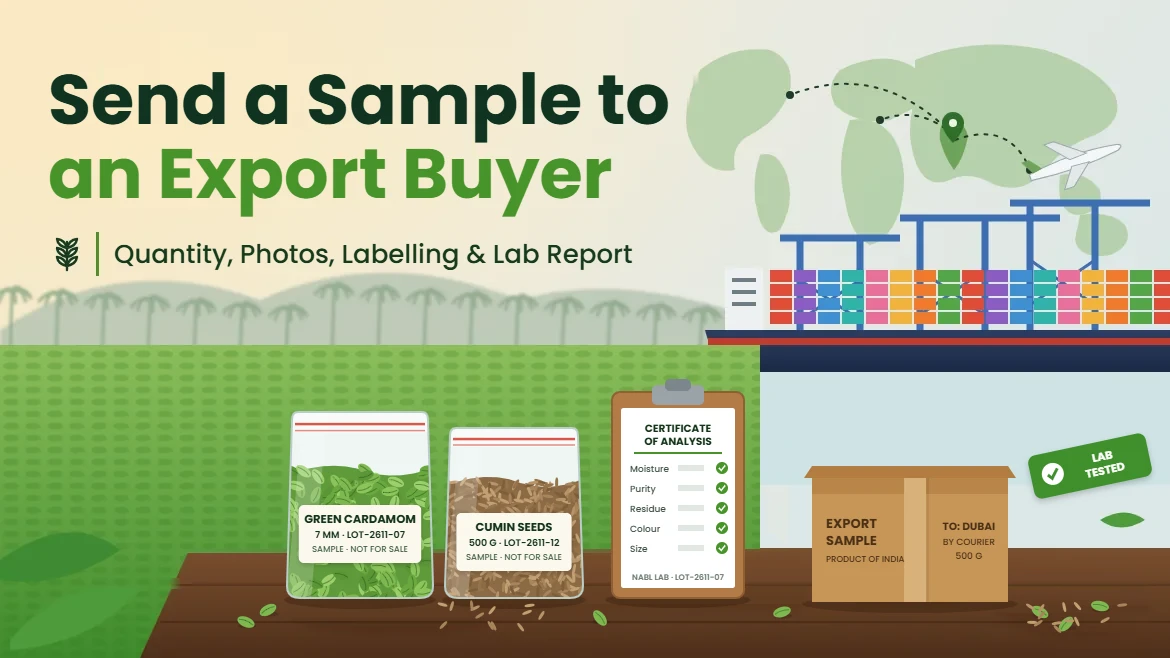
Labelling: every pouch needs its own label. If a buyer opens five samples on the same day and two have no label, yours may get mixed up or set aside. A simple label format that works:
| Field | Example |
| Product | Green cardamom, whole |
| Grade / spec | 7mm, litre weight 415 g |
| Lot number | LOT-2611-07 |
| Origin | Idukki, Kerala, India |
| Crop / packing date | November 2026 |
| Quantity | 500 g |
| Supplier name and contact | Your name, phone, email |
| Marked | Sample, not for sale |
The lot number is the most important line. It links this sample to the stock in your store and to the lab report. When the buyer places an order, they’ll quote that lot number.
The lab report: what buyers expect to see
A serious buyer won’t decide on looks alone. They’ll want a certificate of analysis (CoA): a lab report showing that your product meets their limits. Many buyers test the sample themselves as well. A report from you shows you know what you’re doing, and it saves a week.
Use a proper lab. A report from a NABL accredited lab (ISO/IEC 17025) carries weight. For many export products, APEDA also publishes lists of recognised and authorised laboratories, sorted by product and test type. A local food testing lab without accreditation may be cheaper, but importers often won’t accept its report.
Test the right things. Each product has its usual checks:
| Product | Common tests on the CoA |
| Green cardamom | Moisture, pesticide residue, artificial colour, size and litre weight |
| Cumin seeds | Purity %, moisture, admixture, volatile oil, Salmonella, pesticide residue |
| Rice | Moisture, broken %, average grain length, chalky grains, pesticide residue (especially for basmati going to Europe) |
| Pomegranate | Pesticide residue test against the buyer’s market limits |
Keep the report current. A report should match the lot you’re offering. A report from last year’s crop or a different lot doesn’t count. Put the same lot number on the report and the sample label.
If you’re unsure which tests matter for cumin, our guide on making cumin seeds export-ready covers grades, residue and lot consistency.
Paperwork for sending samples abroad
This is the part that confuses most producers. The good news is that if you work through a sourcing or trading partner, they usually handle the international leg. You send the sample to them within India, and they forward it with the right documents.
If you’re shipping the sample abroad yourself, keep these points in mind:
- A free sample still needs paperwork. It’s still goods crossing a border, so it needs an export declaration in India and an import entry at the destination.
- Courier companies file it for you. Samples sent by an authorised courier usually go under a Courier Shipping Bill (CSB-IV). The courier will ask for KYC details such as GST and PAN before your first export.
- You’ll need an invoice even if you charge nothing. Use an invoice for free samples marked “Sample of no commercial value” or “Free sample, value for customs purposes only”. Show a realistic value. A value that’s too low can hold the parcel at customs.
- Describe the goods properly. Write “Green cardamom whole, 500 g, sample”, not “spices” or “food items”. Add the HS code if you know it.
- Check the buyer’s country. Some countries restrict food, seed or fresh fruit imports, even small amounts. Ask the buyer whether they’ve received samples of this product before without trouble.
Rules change, so confirm the current DGFT and courier requirements before your first shipment.
Keep a counter sample
When you send a sample, keep an identical one, sealed and labelled with the same lot number, in a cool, dry place. This is your counter sample.
If the buyer approves the sample and later complains that the shipment doesn’t match, the counter sample is your proof. The same goes for a pre-shipment sample: if the buyer asks for one before the container leaves, keep a matching half for yourself. It has saved many suppliers from unfair claims.
After the parcel ships: follow up properly
- Send the tracking number and photos of the packed parcel the same day.
- Message the buyer when it’s delivered and ask when they plan to check it.
- Ask for feedback even if the answer is no. “Colour was weak” or “moisture was high” tells you what to fix.
- Note what you sent, which lot, when, and the result. After a few months, this record shows you which grades sell.
This is how most new export buyers are won in this business. It’s less about cold emails and more about a sample, a quick follow-up and a second, better sample.
Mistakes that lose export orders
- Sending a sample better than your real stock
- No label, or a label without a lot number
- Edited photos that don’t match the parcel
- An old or unrelated lab report
- Underdeclaring the value, so the parcel gets stuck at customs
- Going silent after dispatch
- Not keeping a counter sample
For fresh produce, there’s one more: shipping without checking the destination’s rules. Our pomegranate export guide for the UAE covers documents and buyer requirements for that market.
FAQ's
Follow the buyer’s request first. If they leave it to you, 250–500 g per grade of cardamom, 500 g–1 kg of cumin, 1–2 kg of rice, and one packed carton of pomegranates are common amounts.
That’s up to you and the buyer. Many suppliers send the first sample free and ask the buyer to pay for courier on later samples, or adjust the cost against the first order.
India’s trade policy is generally flexible about samples of freely exportable goods, but a sample still goes through customs with an invoice and a declared value. Rules and courier limits change, so check the current DGFT and courier requirements before you ship.
A CoA is a lab report showing your product’s test results, such as moisture, purity or pesticide residue. It isn’t always required for a sample, but serious buyers expect it, and a report from a NABL-accredited lab makes your offer much stronger.
Product name, grade or spec, lot number, origin, crop or packing date, quantity, your contact details and the words “Sample, not for sale”.
It’s an identical portion of the same lot that you keep sealed. If there’s ever a dispute about whether the shipment matches the approved sample, the counter sample settles it.
Have stock ready to sample?
If you grow, aggregate or process green cardamom, cumin, rice or pomegranate and want to reach buyers in the UAE and GCC, send us your supply details: product, grade, location, available quantity, a few clear photos and a lab report if you have one. We’ll tell you honestly whether it fits what our buyers are asking for, and what to send next.