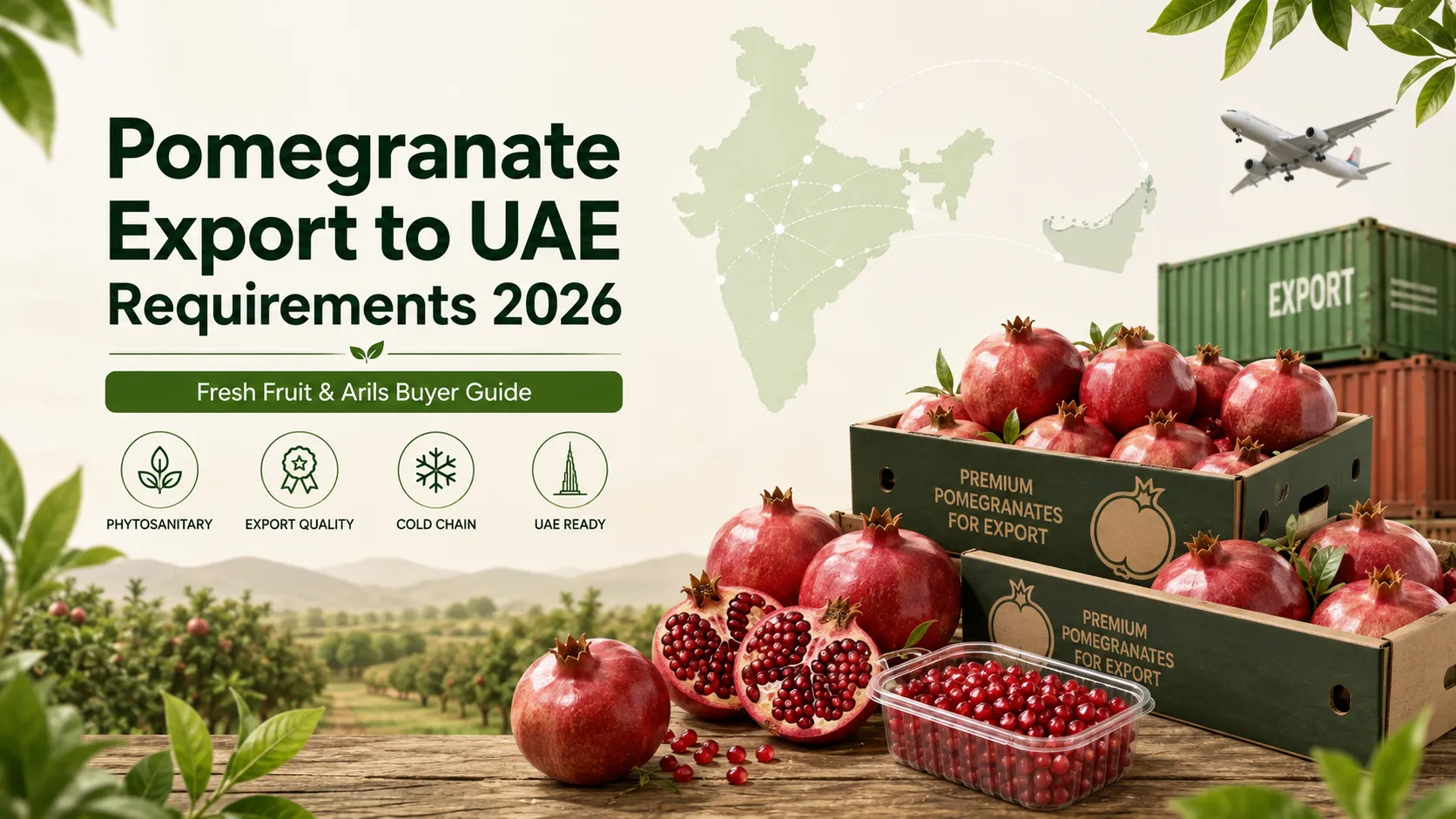
The UAE is one of the most important Middle Eastern markets for fresh Indian fruits, and pomegranate continues to attract demand from importers, wholesalers, supermarkets, hotels and foodservice buyers. India’s combination of commercial production, established packhouses and access to varieties such as Bhagwa makes it an important sourcing market for UAE businesses.
However, successful pomegranate export from India involves much more than finding good-quality fruit. Importers need the right documents, residue compliance, grading, cold-chain handling and pomegranate export packing to protect the consignment from farm to UAE market.
If you are new to sourcing Indian pomegranates, our broader [fresh pomegranate export from India guide] fresh pomegranate export from India guide explains the Indian export ecosystem in more detail. This guide focuses specifically on what UAE buyers should consider in 2026.
Why Does the UAE Import Pomegranates from India?
Known locally in India as anar, pomegranate is grown commercially across several states, with Maharashtra being one of the best-known sourcing regions.
From the pomegranate plant growing in the orchard to grading at an export packhouse, fruit quality depends on variety, agricultural practices, maturity, irrigation, harvesting and post-harvest handling. A healthy pomegranate tree may produce attractive fruit, but not every harvested fruit qualifies for international shipment.
For UAE buyers, Bhagwa is particularly attractive because of its deep external colour, red arils, sweetness and ability to handle commercial transport when properly harvested and stored.
India also offers UAE buyers advantages such as relatively short shipping distances, established trade routes and flexible options for wholesale and retail packing.
UAE Requirements for Fresh Pomegranate Imports in 2026
Fresh fruits entering the UAE must comply with the country’s plant-health and food-safety requirements.
According to the UAE Ministry of Climate Change and Environment’s agricultural consignment release service, imported fresh fruit and vegetable consignments are inspected when they arrive at an approved UAE entry point. Required documentation can include a phytosanitary certificate issued by the exporting country’s competent authority, shipping/customs documentation, certificate of origin where applicable, and a packing list or invoice. UAE Ministry of Climate Change and Environment requirements
For an Indian supplier, a typical shipment file should therefore be prepared around the buyer’s agreed terms and current regulatory requirements.
| Document / Requirement | Why It Matters |
|---|---|
| Commercial Invoice | Shows seller, buyer, value and product details |
| Packing List | Confirms carton count, weight and packing information |
| Bill of Lading / Airway Bill | Transportation document for the shipment |
| Certificate of Origin | Establishes Indian origin where required |
| Phytosanitary Certificate | Confirms compliance with applicable plant-health requirements |
| Residue / Laboratory Report | Supports pesticide-residue and buyer quality requirements where applicable |
| Importer Documentation | Managed by the UAE buyer/importer according to local requirements |
Requirements can change, so exporters and buyers should verify the applicable conditions before loading rather than relying only on documents used for previous shipments.
For businesses still establishing their Indian export documentation, D&S’s [APEDA, FSSAI and IEC registration guide] APEDA, FSSAI and IEC registration guide provides useful background.
Pesticide Residues and Pomegranate Export Quality
Residue compliance is one of the most important issues in fresh-fruit trade.
UAE requirements state that fruits and vegetables must be free from unacceptable pesticide residues or remain within the applicable permitted limits. Buyers should also confirm whether a pesticide-residue analysis certificate is required for their particular product or shipment under current UAE instructions.
This makes farm selection and pre-shipment testing important.
APEDA operates AnarNet, a traceability and quality-assurance system for export pomegranates that supports activities such as farm registration, laboratory residue analysis, packhouse declarations and certification workflows. APEDA AnarNet pomegranate traceability system
For a UAE importer, good pomegranate export quality should therefore mean more than red colour. Fruit should be appropriately mature, clean, consistent in size, free from serious cracks or visible decay, and compliant with the quality specification agreed before shipment.
What Quality Specifications Should UAE Buyers Confirm?
There is no single commercial specification suitable for every buyer. A supermarket programme may require different size counts and appearance standards from a wholesale-market customer.
Before confirming an order, buyers should agree on variety, fruit weight or size range, carton count, colour, maturity or Brix requirement, defect tolerance, net carton weight, packaging style and acceptable residue standards.
Photos and pre-shipment inspection reports are also useful, but they should support not replace a written purchase specification.
Clear specifications reduce disputes once the container reaches Dubai or another UAE destination.
Pomegranate Packing for Export to the UAE
Good fruit can still arrive in poor condition when packaging is weak.
Proper pomegranate packing for export is designed to reduce bruising, skin damage, compression and movement during handling. APEDA publishes a 3.5 kg direct bulk-pack specification for pomegranate, while actual commercial packing can also be customized according to buyer and market requirements.
Common pomegranate export packing uses strong ventilated corrugated cartons, with fruit protected using suitable cushioning, trays or sleeves where required.
Cartons should also carry the agreed shipment and traceability information. The exact design, carton weight, private label and retail presentation should be finalized before production begins.
Buyers sourcing multiple Indian fresh products can also explore D&S International’s [fresh produce sourcing range] fresh produce sourcing range.
Cold Chain Matters as Much as Packing
Temperature management begins before the container leaves India.
After harvest, pomegranates should be handled carefully, graded, packed and moved through an appropriate cold-chain programme. Poor temperature management can accelerate moisture loss, deterioration and visual defects.
The correct storage and transportation settings depend on factors such as variety, maturity, shipment duration, packaging and logistics method. Instead of assuming one reefer setting works for every shipment, UAE buyers should request the exporter or packhouse’s proposed temperature and handling protocol before loading.
Maintaining the cold chain until final distribution is particularly important in the UAE’s warm climate.
What About Fresh Pomegranate Arils?
Pomegranate arils are a separate sourcing opportunity, especially for retail packs, hotels, catering, juice businesses and convenience-food buyers.
However, buyers should not assume that fresh whole fruit and ready-to-eat arils follow exactly the same import procedure.
Once the fruit is opened and the arils are extracted, food-processing hygiene, microbiological safety, shelf life, packaging, refrigeration and labelling become particularly important. Depending on how the product is processed and presented, different food-import requirements may apply.
Therefore, specifications for arils should be agreed separately, including processing conditions, microbiological criteria, pack size, storage temperature, shelf life and UAE importer requirements.
Pomegranate Price and Export Cost
The pomegranate price available in India is not automatically the final export price.
The pomegranate export price in India can change depending on season, variety, fruit size, colour, quality grade, available crop, packhouse processing, carton specification, laboratory testing, inland transportation and freight.
This is why buyers comparing suppliers should request quotations using the same specification and Incoterm. Comparing one supplier’s farm-gate price with another supplier’s packed FOB or CIF offer can give a misleading impression of which shipment is genuinely more economical.
Buyer Checklist Before Confirming a UAE Shipment
Before placing an order, confirm the fruit specification, current UAE import requirements, pesticide-residue expectations, documentation, packaging, cold-chain plan, Incoterm, inspection method and claims procedure in writing.
Price is important, but consistency matters more for repeat business. A slightly cheaper consignment that arrives with mixed sizing, weak cartons or insufficient shelf life can cost an importer significantly more through wastage and customer complaints.
Final Thoughts
The opportunity for pomegranate export from India to the UAE is strong, but reliable trade depends on compliance and execution at every stage. UAE buyers should evaluate not only the fruit itself but also farm traceability, residue control, grading, pomegranate export packing, documentation and cold-chain management.
For Indian suppliers, understanding the buyer’s exact specification before procurement can prevent costly problems after packing or arrival.
D&S International works with buyers and suppliers across fresh produce and international food trade. If you are looking to source Indian pomegranates for the UAE market or discuss quality, packing and supply requirements, [contact D&S International] contact D&S International to discuss your requirement.