Two growers in Idukki pick on the same day. Both have bold, well-filled pods. A month later, one sells at a good rate and the other gets a lower price for the same size. The difference is not the plant. It is what happened after picking.
Green cardamom is sold on colour as much as size. Buyers pay more for pods that stay bright green, and that colour is decided in the first few days after harvest and in how the pods are stored afterwards. This guide explains cardamom processing and storage in simple steps, so your elaichi keeps its colour, smell and price.
This is about small green cardamom (choti elaichi, elakka, elakkai). Large cardamom, or badi elaichi, is a different crop and is dried in a different way.
Why Storage Decides Your Cardamom Price
Every grower watches the cardamom price. Many check the daily cardamom price or the cardamom auction price today before deciding when to sell. But the green cardamom price you actually get depends on the condition of your lot on the day you sell.
Pods that have faded to pale yellow, smell weak or show fungus spots get a lower cardamom price per kg, even in a good market. Well-stored, bright green pods hold their value for months. That gives you a real choice: sell when the cardamom price in Kerala is good, not when your stock is about to spoil.
Harvesting Cardamom at the Right Stage
Good storage starts with harvesting cardamom at the right time. In Kerala, picking goes on for most of the year, with the busiest period around August to October. Growers usually pick each plant about every 45 days.
- Pick pods that are fully mature but still green. Seeds inside should have turned dark.
- Avoid over-ripe pods. They split more easily and lose colour faster.
- Avoid very young pods. They shrink and wrinkle when dried.
- Keep picked pods in the shade and move them to the drier the same day.
Cardamom Processing: Dry Within a Day
At harvest, fresh pods are very wet. Kerala Agricultural University advises that capsules should be processed within 24 to 36 hours of harvest to prevent colour loss. Wait longer and the green starts turning yellow before drying even begins.
Washing and soaking
Wash the pods in clean water to remove soil and dust. Some growers then soak them for 10 minutes in a 2% washing soda (sodium carbonate) solution before drying. According to the university, this helps the pods hold their green colour much longer in storage.
Drying temperature step by step
Most curing houses use a firewood kiln or an electric dryer. Spread the pods thinly on wire-mesh trays and turn them often. A typical pattern looks like this:
| Stage | What happens | Why it matters |
| Harvest | Pods carry roughly 70–80% moisture | Wet pods start losing colour within a day |
| Start drying | Within 24–36 hours of picking | Delay turns pods yellow or brown |
| First 4 hours | About 50°C | Removes surface water fast |
| Main drying | Reduced to about 45°C, fans and vents open | Slow, even drying keeps the green |
| Final hour | Raised to about 60°C | Finishes the pod so it stores well |
| End point | Moisture brought down to about 10–11% | Dry enough to store without fungus |
Too much heat cooks the pods and turns them brown. Too little heat leaves them damp. Sun drying is cheaper, but it usually gives patchy colour and surface marks, so it rarely gets the best green cardamom price.
Cleaning and grading after drying
Once dry, rub the pods on a wire mesh to remove stalks and dried flower parts. Then sieve them by size. Our guide to green cardamom grades explains the 5mm, 6mm and 7mm sizes buyers ask for.
Cardamom Moisture: The Number That Matters Most
Cardamom moisture is the main reason stored elaichi spoils. If pods go into bags while still damp, fungus grows inside the bag and the whole lot can be ruined in weeks.
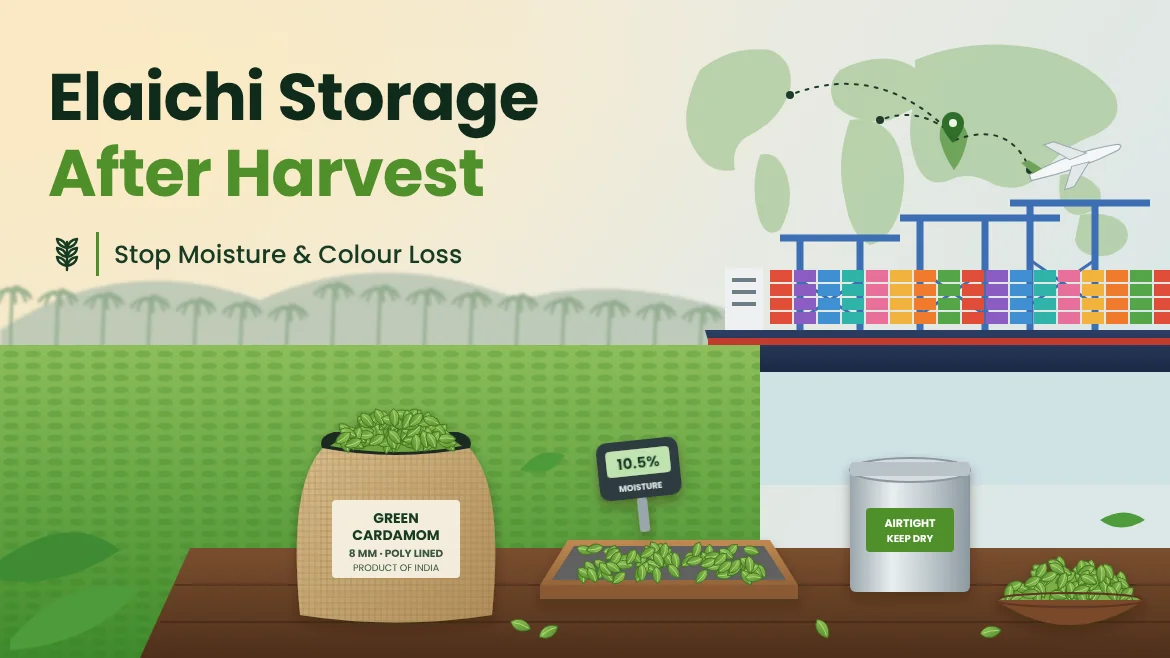
Properly cured cardamom is brought down to about 10–11% moisture. Some processing guides suggest going as low as 8–10% for long storage. If you sell regularly, a simple grain moisture meter is worth buying. If you don’t have one, break a few pods: seeds should be hard and the husk should crack, not bend.
Never bag pods that are still warm from the dryer. Let them cool fully first, or the warmth will turn into moisture inside the bag.
Best Way to Store Cardamom After Harvest
The aim is simple: keep out light, air, moisture and smells. Light fades the green, air carries away the aroma, and moisture brings fungus.
Bags and containers
- Polythene-lined gunny bags: the standard for growers. The inner plastic layer blocks moisture and helps keep the green colour.
- Black polythene liners: many growers prefer black or dark liners because they also block light.
- Wooden boxes or bins: for long storage, keep the lined bags inside wooden boxes to protect them from damp floors and pests.
- Airtight tins or drums: good for smaller quantities and samples.
Godown conditions
- Keep bags on wooden pallets, never directly on the floor or against walls.
- Choose a dry, dark, well-ventilated room.
- Keep cardamom away from fertiliser, pesticides, diesel and other strong smells. Pods absorb odours easily.
- Check stock every few weeks for damp patches, insects or a musty smell.
What not to do
- Don’t add artificial colour to make pods look greener. The Spices Board tests for it, and it can get a whole lot rejected.
- Don’t mix old and new crop in one bag.
- Don’t open bags again and again. Each time, air and moisture get in.
Store or Sell: Watching the Cardamom Price
Good storage lets you wait for a better rate instead of selling in a hurry. Many growers follow the cardamom price in Idukki and the e-auctions at Puttady and Bodinayakanur, and track the cardamom price in Bodinayakanur and the cardamom price in Kerala today before releasing stock.
Keep in mind that the elaichi cost per kg you pay for drying, bags and labour stays the same whether you sell today or in three months. Holding stock only makes sense if your storage keeps the quality intact. A faded lot sold later can earn less than a bright lot sold early, even if the small cardamom price has gone up.
Final Thoughts
Cardamom processing and storage are where a good crop keeps its value or loses it. Dry quickly, get the moisture right, bag it properly and store it in the dark. Do this well and you can sell when the price suits you, not when your stock forces you to.
If you run a cardamom business or grow green cardamom in commercial quantities, export buyers will always ask about colour, grade and moisture. Our guide on making green cardamom export-ready explains what else they check. D&S International sources cardamom for export to the UAE and other markets, and you can see the spices we buy on our spices page. Have well-stored stock ready? Share your grade and quantity with our team.
FAQ's
Properly dried cardamom stored in polythene-lined bags, away from light and moisture, can keep its quality for several months. Colour fades faster if pods were dried late or stored damp.
Usually because drying started too late after picking, the drying heat was uneven, or the pods were exposed to light and air during storage.
Bring cardamom moisture down to about 10–11% before storing. For longer storage, some guides recommend 8–10%.
Dry it within a day of picking, cool it fully, store it in polythene-lined bags in a dark, dry room, and keep it away from strong smells.