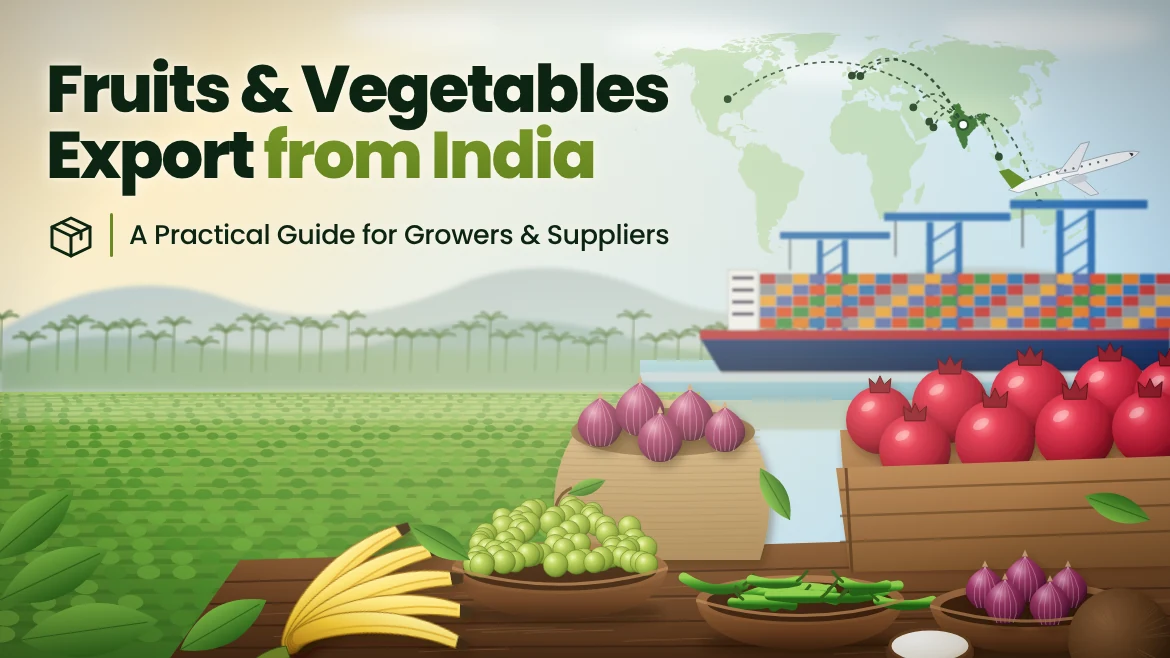
Walk into any supermarket in Dubai and you will see it: Indian pomegranates, Nashik onions, green chillies and bananas stacked right at the front. Most of that produce started on a small farm in Maharashtra, Karnataka or Gujarat. The farmer who grew it often had no idea it would end up abroad.
That gap is the opportunity. Fruits and vegetables export from India is growing every year, yet many growers, FPOs and local traders still sell only to the nearest mandi at whatever price the day offers. Export buyers pay for quality, consistency and proper packing, and they buy in volume.
This guide explains how fruits export and vegetables export from India actually work. You will learn which products sell, where they go, what papers are needed, how vegetable export packing is done, and how to sell to an overseas buyer even if you never become an exporter yourself.
Why India Is a Big Player in Fruits and Vegetables Export
India grows almost everything. The climate runs from the cold hills of Himachal to the tropical coast of Kerala. That means fresh produce is available somewhere in the country in every season.
The numbers back this up. According to APEDA, India produced about 117.65 million tonnes of fruits and 217.80 million tonnes of vegetables in FY25. India is the world’s top producer of bananas, mangoes and papayas, and the largest producer of okra.
Exports are growing too. In 2025-26, India shipped fresh fruits and vegetables worth about USD 1,921 million:
| Category | Export value FY26 (USD million) |
|---|---|
| Fresh fruits | 1,161.31 |
| Fresh vegetables | 760.08 |
| Total | 1,921.42 |
Still, India holds only about 1% of the global fresh produce market. For a country that grows this much, there is a lot of room to grow.
Top fruits exported from India
- Grapes: mostly from Nashik and Sangli, shipped to Europe and the Gulf
- Pomegranates: the Bhagwa variety from Maharashtra is a buyer favourite
- Mangoes: Alphonso, Kesar and Banganapalli in season
- Bananas: G9 (Cavendish) from Jalgaon, Andhra Pradesh and Gujarat
- Oranges and coconuts: steady demand from neighbouring and Gulf markets
Top vegetables exported from India
- Onions: India’s biggest vegetable export, led by Nashik and Lasalgaon
- Mixed vegetables: okra, drumstick, bitter gourd and tindora for Indian diaspora shops
- Potatoes and tomatoes: mainly to nearby countries
- Green chillies: high demand in the Gulf for daily cooking
Where Indian Fruits and Vegetables Go
APEDA lists the UAE as the top destination for Indian fresh fruits and vegetables. It is followed by Iraq, the Netherlands, Nepal, Malaysia, Bangladesh, Sri Lanka, the UK, Uzbekistan and Oman.
The Gulf deserves special attention for three reasons:
- Short transit. A container from Mundra or Nhava Sheva reaches Jebel Ali in about four to six days. That suits short-shelf-life items like green chillies and leafy vegetables.
- Familiar taste. A large Indian and South Asian population means steady demand for the exact varieties Indian farms already grow.
- Re-export hub. Dubai sends produce onward to Saudi Arabia, Oman, Iran and Africa, so one buyer in the UAE can open many markets.
Europe pays more but is much stricter on pesticide residue. For a first-time supplier, the Gulf is usually the easier place to start.
How Fruits and Vegetables Export from India Works: Step by Step
The process looks complicated from outside, but it follows a clear order.
- Get an IEC. The Importer Exporter Code from DGFT is the basic licence for any export. It is issued online against your PAN.
- Register with APEDA. Fresh fruit and vegetable exporters need an RCMC from APEDA. Some products, like grapes and pomegranates, also need farm registration on traceability systems such as GrapeNet or HortiNet.
- Pick the right product and market. Each country has its own rules. Check the importing country’s requirements on APEDA’s portal before you commit.
- Grade, sort and pre-cool. Remove damaged pieces, sort by size and colour, and bring the field heat down quickly. This step decides shelf life.
- Pack to export standard. Use the right carton, bag or crate for the product (more on this below).
- Arrange inspection and documents. The plant quarantine office checks the lot and issues the phytosanitary certificate.
- Ship. Sea freight in reefer containers for most items, air freight for very short-life produce.
Documents usually needed
- Commercial invoice and packing list
- Phytosanitary certificate
- Certificate of origin
- Shipping bill (filed through customs)
- Bill of lading or airway bill
- Lab test report for pesticide residue, if the buyer asks for it
If the buyer wants organic produce, you will also need NPOP organic certification and TraceNet records.
Vegetable Export Packing and Packaging: Get This Right
Good produce with poor packing loses money. Bruised onions, sweating chillies and crushed tomatoes are the most common reasons a buyer cuts the price or rejects a lot.
APEDA and the Indian Institute of Packaging (IIP) have published packaging specifications for most major fruits and vegetables. For onions and potatoes, for example, the recommended carton is corrugated fibre board of about 400 × 300 × 180 mm.
Common vegetable export packaging options
| Packaging | Best for | Why it works |
|---|---|---|
| Mesh (leno) bags, 5–25 kg | Onions, potatoes | Lets air flow and keeps the bulbs dry |
| Ventilated corrugated cartons | Green chillies, okra, tomatoes | Protects soft produce and stacks well in containers |
| Plastic crates | Leafy and delicate items | Strong and reusable, good for short trips |
| Telescopic cartons with liners | Grapes, pomegranates | Controls moisture and cushions the fruit |
Simple vegetable export packing tips
- Pack only clean, dry, fully graded produce
- Keep one size grade per box, so the buyer sees consistency
- Do not overfill; pressure causes bruising in transit
- Print the product, variety, net weight, grade, packer name and “Product of India” on every carton
- Use ISPM 15 heat-treated pallets if you ship on wooden pallets
- Ask the buyer about retail packs; some Gulf buyers want 500 g or 1 kg punnets ready for shelves
Cold Chain: The Part Most First-Timers Underestimate
Fresh produce keeps breathing after harvest. Every hour it sits in the heat, its shelf life shrinks. That is why serious vegetable exporters pre-cool the produce within hours of picking and ship it in temperature-controlled reefer containers.
Each product has its own comfort zone. Grapes travel close to 0–2°C, while mangoes and bananas need warmer settings so they do not get chill damage. Getting the temperature wrong can ruin a full container.
Why Export Shipments Get Rejected
Most rejections come down to a handful of mistakes:
- Pesticide residue above the importing country’s limit, the biggest issue for Europe
- Mixed sizes or grades in the same box
- Moisture and rot from packing produce that was wet or still warm
- Missing or mismatched documents, such as a wrong HS code or weight
- Weak cartons that collapse when stacked in the container
The fix is simple discipline: test before you pack, grade strictly and check every document against the invoice.
You Don’t Have to Become an Exporter to Sell Abroad
Here is something many growers don’t know. You can supply export markets without holding an IEC, chasing customs or finding buyers overseas.
Many producers and FPOs work with an importer or trading partner in the destination country. You focus on what you do best: growing, grading and packing to the agreed specification. The importer handles buyer demand, shipment coordination, documentation guidance and delivery on the other side.
This route suits farmers, FPOs and small agri businesses that have good produce but no export team. It lowers your risk, gives you access to bigger and more regular orders, and lets you learn how agri export works before investing in your own setup.
Final Thoughts
Fruits and vegetables export from India is no longer only for large companies. Demand in the Gulf is steady, transit times are short, and buyers are actively looking for reliable Indian suppliers. What wins orders is not size but discipline: clean grading, the right vegetable export packaging, a working cold chain and correct paperwork.
Start with one or two products you already grow well. Learn the buyer’s specification, pack it right, and build from there.
Grow, pack and supply. We’ll handle the rest. D&S International is a Dubai-based importer that sources onions, pomegranates, green chillies, bananas, grapes, coconuts and more from Indian growers and suppliers for buyers across the UAE and GCC. Talk to our team about supplying your produce.
FAQ's
Grapes, pomegranates, mangoes, bananas and oranges lead fruits export from India. On the vegetable side, onions are the biggest item, followed by mixed vegetables, potatoes, tomatoes and green chillies.
Yes. Anyone exporting fresh fruits or vegetables in their own name needs an IEC from DGFT and an RCMC from APEDA. If you supply through an importer or merchant exporter, they handle the export registration.
The UAE is the top destination, according to APEDA. Iraq, the Netherlands, Nepal, Malaysia and Bangladesh are also major buyers.
It depends on the product. Onions and potatoes usually go in mesh bags or corrugated cartons. Soft items like chillies, okra and tomatoes travel in ventilated cartons or plastic crates.
Yes, by getting an IEC and APEDA registration. Many choose to start by supplying an importer instead, which avoids the paperwork and buyer search while they learn the trade.