When international buyers source rice from India, grain quality and price usually get most of the attention. But rice export packaging can be just as important. The wrong bag size or packaging material can increase repacking costs, affect shelf presentation, expose rice to moisture, or create labeling problems at the destination.
For importers, distributors, wholesalers, food-service companies and private-label buyers, rice packaging for export should therefore be agreed before the purchase order is finalized.
India is already one of the world’s major rice suppliers. APEDA reports that India exported 15.01 million MT of non-Basmati rice during 2025–26, showing the scale at which Indian rice moves through international supply chains.
APEDA – Non-Basmati Rice
If you are new to sourcing Indian rice, our complete rice export from India guide explains the broader export process. Here, we focus specifically on choosing between 5kg, 10kg, 25kg and 50kg rice bags.
Why Does Rice Export Packaging Matter?
Export packaging has three basic jobs: protect the rice, make handling easier and present the product correctly to its final buyer.
A supermarket importer may need attractive 5kg or 10kg printed bags that can move directly onto retail shelves. A wholesaler, restaurant supplier or institutional buyer may prefer 25kg or 50kg bags because they are more practical for bulk handling.
Packaging can also influence:
- Moisture protection
- Bag strength during transportation
- Warehouse stacking
- Product traceability
- Branding
- Private labeling
- Container handling
- Retail presentation
FSSAI’s Packaging Regulations require materials that come into direct contact with food to be food-grade and suitable for the product, storage conditions and transportation.
FSSAI – Food Safety and Standards Packaging Regulations
Importers should also remember that the destination country’s packaging and labeling requirements may be different from Indian requirements.
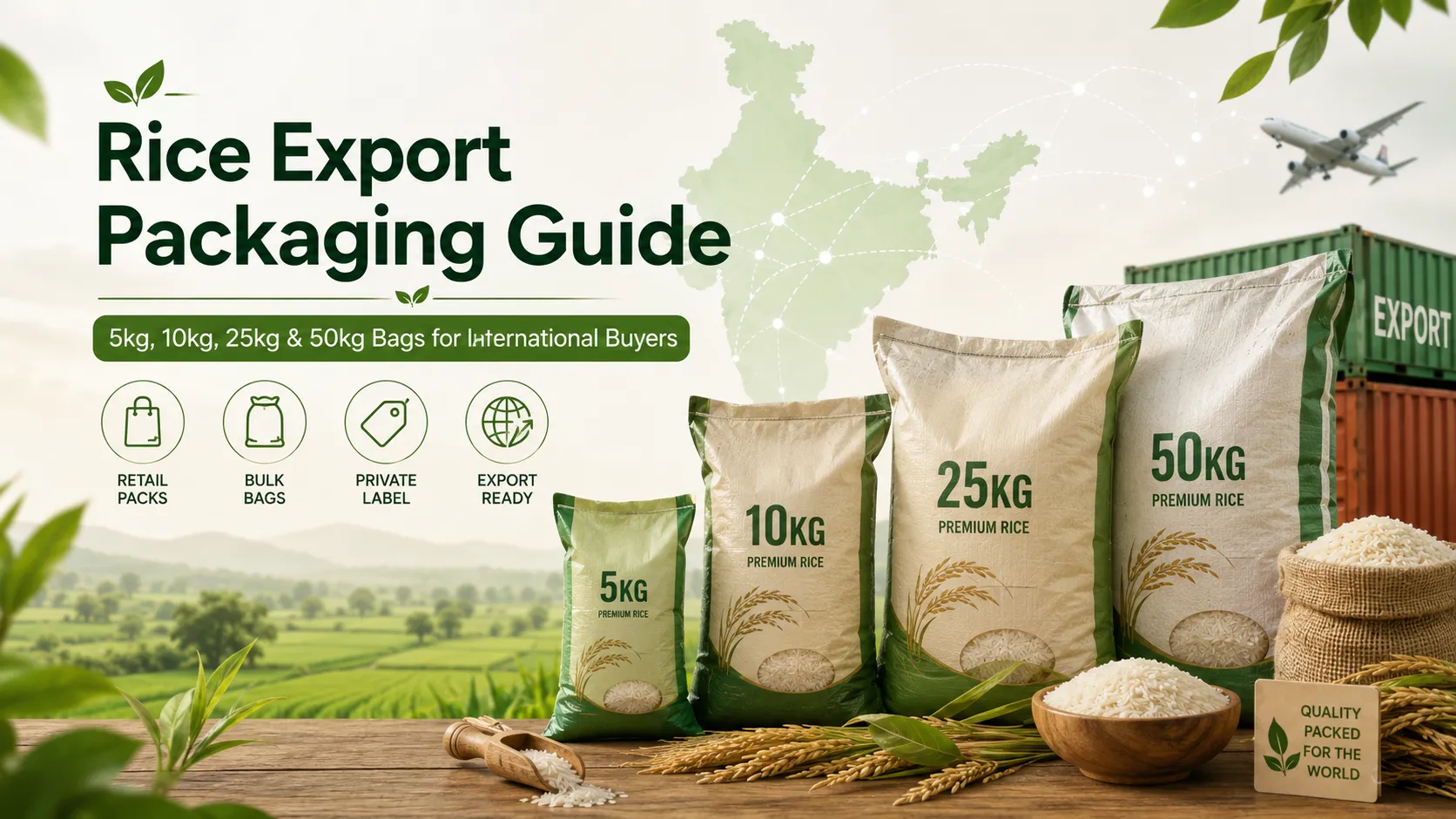
5kg vs 10kg vs 25kg vs 50kg Rice Packaging
| Pack Size | Best Suited For | Common Packaging Approach |
|---|---|---|
| 5kg | Supermarkets, retail buyers, households | Printed/BOPP retail packaging |
| 10kg | Family packs, grocery stores, semi-wholesale | Branded retail or laminated bags |
| 25kg | Restaurants, distributors, catering companies | PP woven or laminated bags |
| 50kg | Wholesalers, institutional buyers, bulk trade | Heavy-duty PP woven bags |
The best size depends less on the rice itself and more on how your customer intends to sell or use it.
5kg Rice Bags: Best for Retail and Brand Visibility
A 5kg rice bag is mainly a retail-oriented format. It works particularly well for Basmati, premium long-grain rice and products distributed through supermarkets, hypermarkets and branded grocery channels.
At this level, packaging becomes part of the product’s identity.
Buyers may request:
- High-quality printed artwork
- Brand logo
- Carry handle
- Transparent product window
- Barcode
- Bilingual or multilingual labeling
- Importer information
- Private-label design
BOPP laminated woven bags and suitable food-grade retail pouches are often considered when appearance matters.
If you are evaluating different rice varieties before deciding on packaging, our non-Basmati rice export guide explains commonly traded Indian non-Basmati varieties and buyer considerations.
10kg Rice Bags: Retail Convenience with Better Bulk Economics
The 10kg rice bag sits between consumer-sized retail packaging and commercial bulk packs.
It can be suitable for:
- Large families
- Ethnic grocery stores
- Independent retailers
- Semi-wholesale customers
- Smaller restaurants
- Food-service operators
Compared with 5kg packs, 10kg packaging can reduce packaging cost per kilogram while still remaining convenient for consumers and retailers.
It also provides enough surface space for branding, product information, country of origin, importer details and cooking instructions where required.
For private label rice packaging, 10kg can be particularly attractive for brands that want a value-oriented family pack without moving into commercial 25kg bags.
25kg Rice Bags: A Strong B2B Packaging Option
For B2B rice trading, 25kg rice bags provide a practical balance between handling convenience and bulk economics.
They are commonly suitable for:
- Restaurants
- Catering companies
- Rice distributors
- Wholesalers
- Food processors
- Institutional buyers
PP woven bags are widely used in bulk food logistics because they offer good mechanical strength and cost efficiency. Current export-market supplier pages also commonly offer 25kg and 50kg PP packaging for rice.
Depending on shipment conditions, buyers may also request lamination or an inner liner for additional protection against humidity.
A 25kg packaging specification should clearly mention:
Net weight + bag material + printing + liner requirement + stitching/sealing method + buyer branding.
Importers should also verify the exporter’s registrations and compliance documentation. Our guide to APEDA, FSSAI and IEC registration for food export explains the core Indian food-export registration framework.
50kg Rice Bags: Designed for High-Volume Trade
The 50kg rice bag is generally more suitable for buyers focused on bulk movement rather than consumer-facing presentation.
Typical customers include:
- Large wholesalers
- Food-service distributors
- Institutional procurement companies
- Commercial food processors
- Bulk commodity buyers
Bag strength becomes particularly important at this size. The packaging must withstand warehouse handling, container stuffing, stacking and international transportation.
Plain or printed PP woven rice bags are commonly used for bulk shipments, while inner liners may be added where additional moisture protection is required.
However, buyers should not choose 50kg packaging simply because the packaging cost per kilogram appears lower.
If the rice will ultimately be repacked into 5kg bags after arrival, local repacking can add labor, packaging, warehouse and compliance costs. In some cases, asking the Indian exporter to supply finished private-label packs can be more efficient.
Which Rice Packaging Material Should Buyers Choose?
PP Woven Bags
PP woven bags are commonly used for 25kg and 50kg rice packaging because they offer strength, ease of handling and cost efficiency.
BOPP Laminated Bags
BOPP rice bags are more branding-focused. They support attractive printing and can be useful for supermarket and private-label products.
They are especially relevant when the importer wants packaging that is ready for retail display.
Jute Bags
Jute packaging can provide a traditional or premium appearance for certain specialty rice markets.
However, buyers should discuss moisture protection, inner lining and storage conditions before choosing jute packaging for a long sea shipment.
Bags with PE Inner Liners
A PE inner liner can provide an additional barrier against humidity and contamination.
This may be worth considering for long-distance shipments or destinations with humid storage and transportation conditions.
What Should Buyers Confirm Before Packaging Starts?
Before printing thousands of bags, the importer and exporter should approve a written rice packaging specification.
Confirm:
- Rice variety and grade
- 5kg, 10kg, 25kg or 50kg pack size
- Packaging material
- Inner liner requirement
- Net weight
- Bag dimensions
- Brand artwork
- Barcode
- Country of origin
- Importer information
- Languages required
- Batch or lot information
- Closure or stitching method
- Destination-country labeling requirements
For companies sourcing for Gulf markets, our guide to trusted Indian food exporters for the UAE market also explains important supplier-selection considerations.
Private Label Rice Packaging: What Should You Send the Exporter?
If you want rice supplied under your own brand, avoid sending a request that simply says “Need custom packaging.”
Send a proper brief containing:
- Rice variety
- Grade or broken percentage
- Pack size
- Bag material
- Brand artwork
- Required languages
- Barcode
- Importer details
- Destination country
- Total order quantity
- Certification requirements
- Special labeling instructions
Before mass printing, ask for a digital artwork proof or packaging sample.
Checking the artwork at this stage can prevent expensive mistakes involving incorrect weights, spelling, barcodes, importer details or regulatory declarations.
Final Thoughts
There is no single best rice export packaging size.
Choose 5kg when retail presentation and consumer branding matter most. Choose 10kg for family packs and semi-wholesale channels. 25kg rice bags work well for food service, restaurants and distributors, while 50kg rice bags are better suited to high-volume wholesale and institutional trade.
Most importantly, packaging should be treated as part of the rice specification—not something decided after the rice has already been purchased.
A clear packaging brief helps the supplier provide an accurate quotation, protects rice during transportation and reduces the chance of repacking or labeling issues at the destination.
D&S International works with international buyers sourcing Indian agricultural and food products. Buyers looking for Indian rice can share their required rice variety, grade, quantity, packaging size, destination port and private-label requirements to receive a shipment-specific quotation.