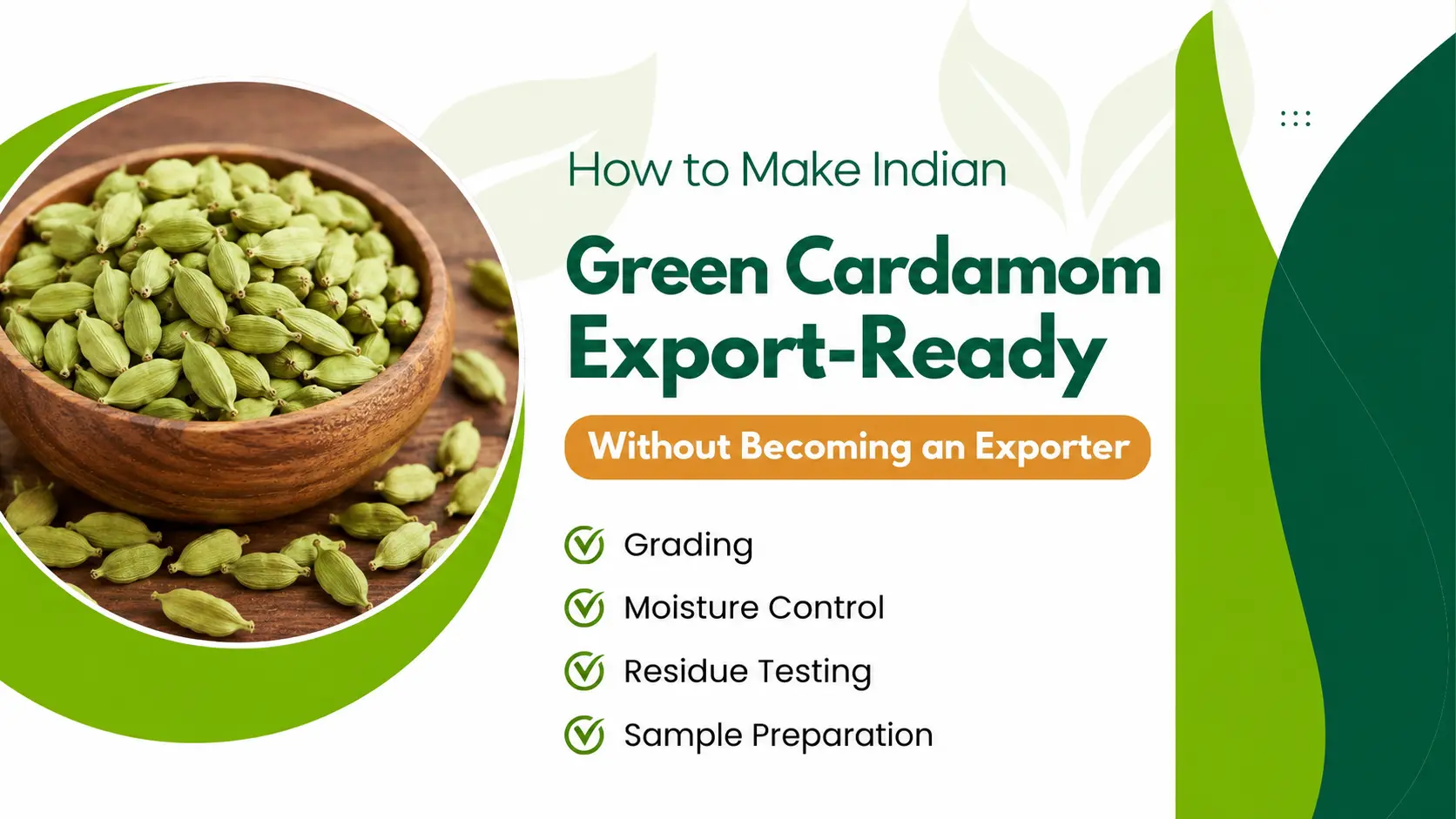
Producing high-quality green cardamom is only the first step. If you want your crop to move beyond the local market and become suitable for international buyers, exporters or sourcing companies, your product must also be commercially ready.
Many growers entering the cardamom business assume they need to become exporters themselves. In reality, a producer can focus on growing, grading and preparing quality cardamom while working with the appropriate trade and export partners.
Why Export-Ready Cardamom Matters
India has an established position in global spice trade. World Bank trade data shows that India exported about $203.6 million of cardamom in 2024, with the UAE being India’s largest reported destination for cardamom that year at about $80.5 million.
That makes india uae trade particularly relevant for Indian producers looking at premium spice markets.
However, successful cardamom export depends on more than having stock available.
Bulk buyers generally want to understand:
- Origin and grade
- Pod size
- Colour and appearance
- Moisture condition
- Cleanliness
- Broken or split pods
- Quantity available
- Monthly supply capacity
- Product consistency
- Sample availability
- Laboratory reports where required
A producer who says, “I have 1,000 kg of cleaned 7–8 mm elaichi from Idukki” provides a much stronger commercial starting point than someone who simply says, “I have cardamom for sale.”
1. Understand Your Green Cardamom Grade
One of the first steps in preparing cardamom for bulk buyers is separating the crop into commercially useful grades.
Common size categories include:
6–7 mm: suitable for various commercial requirements
7–8 mm: commonly traded higher-grade material
8 mm+: bold pods often positioned toward premium demand
Size matters, but it should never be evaluated alone.
Colour, seed fill, aroma, cleanliness, splits and consistency can also influence how a buyer evaluates the lot.
Also remember that cardamom seeds and whole green-cardamom pods may fall under different commercial specifications and HSN classifications, so suppliers should clearly identify exactly what they are offering.
For growers researching cardamom suppliers in india, this is an important lesson: professional suppliers normally present products through specifications rather than simply quoting “best quality cardamom.”
Have commercial quantities available?
Share Your Cardamom Supply Details with D&S, including your grade, location and current quantity.
2. Protect Colour, Aroma and Moisture
Even excellent cardamom can lose commercial quality because of poor post-harvest handling.
Improper moisture conditions can affect storage stability, while unsuitable storage may reduce aroma, appearance and overall product quality.
Do not assume that one moisture number applies to every international buyer. Specifications may change according to customer requirements and destination markets.
Instead, know the actual condition of your lot and store it in clean, dry conditions away from moisture, contamination and strong odours.
The objective is simple:
the quality approved in the sample should be reasonably consistent with the quality delivered in bulk.
3. Treat Pesticide Residues as a Commercial Issue
A visually attractive pod is not automatically export-ready.
International food markets increasingly evaluate pesticide residues and food-safety requirements. The Spices Board’s Quality Evaluation Laboratory at ICRI Myladumpara specifically performs pesticide-residue analysis on small-cardamom samples at farm-gate level and also checks small cardamom for artificial colouring.
That makes testing and responsible crop-protection practices important for growers interested in export-oriented supply.
Maintain records wherever practical and arrange appropriate testing when the buyer or market requires it.
Never promise “export quality” simply because your cardamom looks good.
4. Clean, Sort and Maintain Lot Consistency
For a serious buyer, consistency is often more important than one impressive handful of pods.
Your commercial lot should be properly sorted and cleaned, with unwanted foreign matter and clearly defective material removed.
Avoid sending a perfect 500-gram sample when the remaining 800 kg is noticeably different.
A better principle is:
Representative sample = representative commercial lot.
That becomes particularly important when dealing with established cardamom exporters in india, wholesalers or international sourcing companies that may be buying repeatedly.
5. Create a Buyer-Ready Specification
A grower or supplier does not need an expensive brochure to start a commercial discussion.
You need accurate information.
Example Cardamom Supply Specification
| Specification | Example |
|---|---|
| Product | Indian Green Cardamom |
| Origin | Idukki, Kerala |
| Grade | 7–8 mm |
| Current stock | 1,000 kg |
| Monthly availability | 300–500 kg |
| Crop | Current crop |
| Cleaning | Cleaned and sorted |
| Moisture | Tested / test available |
| Residue report | Available / pending |
| Sample | Available |
| Location | Idukki |
| Photos/video | Available |
This immediately helps a buyer or sourcing partner decide whether your stock is relevant.
6. Know Your Supply Capacity
There is a major commercial difference between:
“I have elaichi.”
and:
“I currently have 900 kg of 7–8 mm green cardamom in Kerala and can supply approximately 300 kg each month.”
For producers serious about building a cardamom business, always know:
current stock + grade + location + monthly capacity + sample availability.
These details help separate genuine commercial suppliers from casual enquiries.
7. Do You Need to Become an Exporter?
Not necessarily.
A producer’s strength may be cultivation, aggregation or consistent product supply—not documentation, customs procedures, freight booking and overseas buyer coordination.
That is where an appropriate import export supply chain or professional export service can become useful.
D&S International says it sources agricultural products from manufacturers, farmers and traders while managing areas such as product verification, quality checks, documentation and international supply coordination.
If you want to understand the complete cardamom export procedure from India to the UAE, use D&S’s existing dedicated export guide rather than trying to make this article cover the same information.
Cardamom Production in India and Global Opportunity
cardamom production in india is concentrated primarily in the southern growing regions. The Spices Board identifies Kerala as the major small-cardamom-producing state, followed by Karnataka and Tamil Nadu.
This gives growers in these regions access to an established ecosystem of farmers, traders, auction participants, processors and exporters.
Cardamom also belongs to the wider category of food products exported from india, alongside rice, fruits, vegetables and other spices.
For growers exploring the top exports of india, the practical lesson is not to chase every export opportunity. Focus instead on producing a consistent, well-documented product that matches a buyer’s requirement.
India vs the Largest Exporter in the World
A common search question is: Which country is the largest exporter in the world for cardamom?
According to 2024 World Bank/WITS trade data, Guatemala ranked first in cardamom exports, followed by India. Guatemala exported about $499.7 million, compared with India’s roughly $203.6 million.
People also frequently search largest producer of cardamom in world, but production and export rankings are not always the same measurement. For commercial decisions, suppliers should distinguish between production data and actual international trade data.
What Are the top Cardamom HSN Codes?
For Indian trade classification, cardamom falls within heading 0908. DGFT classifications include:
09083120 – Small (Elettaria), Alleppey green
09083130 – Small, Coorg green
09083150 – Small mixed
09083210 – Cardamom powder
09083220 – Small cardamom seeds
The correct code depends on the exact product being traded, so exporters should verify classification before documentation.
What About UAE Import Regulations?
Producers do not need to memorize every destination-country rule, but they should understand that UAE import regulations can include mandatory food-sector specifications and buyer-specific quality requirements. The UAE maintains official mandatory standards for food products, so the export partner/importer should verify the current requirements for the shipment.
This is another reason a farmer can focus on making the product commercially ready while leaving destination-country compliance to the appropriate export and import partners.
Have Green Cardamom Available in Bulk?
If you are a farmer, producer group, aggregator or bulk supplier in India, D&S International can evaluate potential sourcing requirements for international markets.
Yes. A farmer or producer can participate in the appropriate domestic licensed trade channel and work with an export partner for the export-side process. The commercial structure should comply with the applicable Cardamom Licensing and Marketing Rules.
Do not judge export quality only by pod size or colour. Buyers may consider grade, cleanliness, moisture, aroma, defects, pesticide residues, lot consistency, packaging and destination-specific requirements.
No. Larger pods may be positioned toward premium requirements, but different buyers need different grades. A consistent 7–8 mm lot can also have strong commercial relevance when it matches the buyer’s specification.
First make your stock easy to evaluate. Prepare the grade, quantity, origin, photographs, sample and repeat supply capacity. Then approach established licensed trade channels, sourcing companies and export partners.
Share your location, supplier type, grade, quantity currently available, monthly capacity, recent product photographs and whether a representative sample or laboratory report is available.