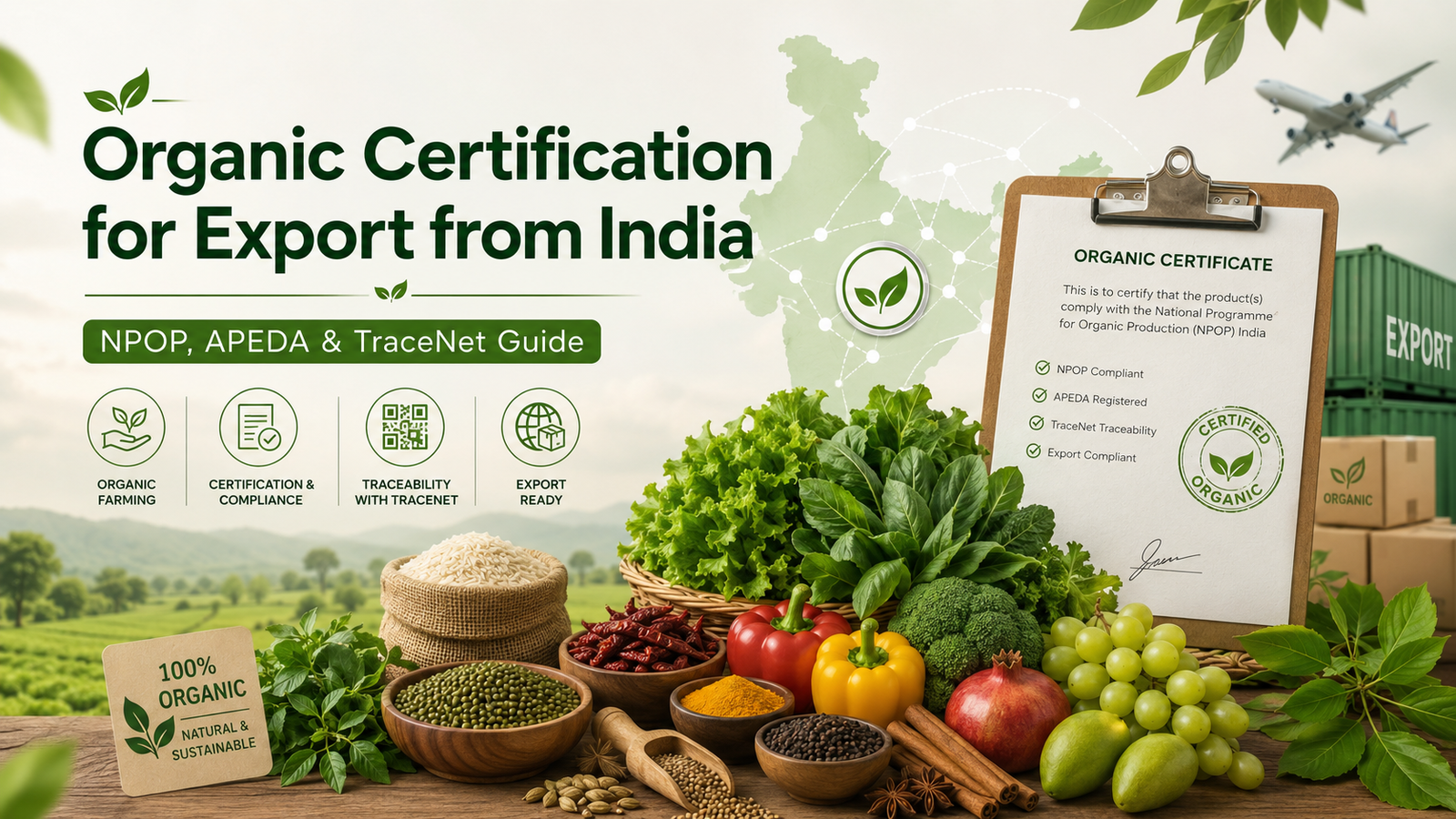
India has enormous potential in the global organic food market. But growing crops without synthetic fertilizers or pesticides is not enough to sell a product internationally as “organic.” For export markets, the claim must be backed by an approved certification and traceability system.
For Indian farmers, processors, traders and exporters, this is where NPOP, APEDA and TraceNet come together.
Understanding how these systems work can help businesses avoid certification delays, documentation gaps and problems when dealing with overseas buyers.
According to APEDA, India exported around 368,155 MT of organic products worth US$665.97 million during 2024–25. These exports included cereals, processed foods, oilseeds, spices, pulses, fresh fruits and vegetables and other agricultural products.
For businesses looking at agriculture and food product export from India, organic certification can therefore be much more than a compliance requirement. It can provide access to premium buyers and markets where certified sourcing and traceability matter.
Organic Certification in India for Export
Organic certification in India confirms that the production, processing and handling of a product comply with an approved organic standard.
For exports under India’s National Programme for Organic Production (NPOP), certification is carried out through accredited certification bodies.
NPOP is implemented by the Agricultural and Processed Food Products Export Development Authority—APEDA—under the Ministry of Commerce & Industry.
The programme covers areas such as:
- Standards for organic production
- Inspection and certification of operators
- Accreditation of certification bodies
- Grower-group certification
- Processing and handling requirements
- Traceability
- Use of the India Organic logo
The official APEDA National Programme for Organic Production portal provides the current NPOP framework, certification-body information and organic-export resources.
This also explains the commonly searched term APEDA organic certification. APEDA administers the NPOP framework and accreditation system, while an accredited certification body actually inspects and certifies the operator.
Organic certification should also not be confused with general exporter registrations. Businesses still need to understand requirements such as IEC, APEDA registration and applicable food licences. Our APEDA, FSSAI and IEC registration guide explains these requirements separately.
NPOP Organic Certification Process
The exact process depends on whether the applicant is an individual farm, grower group, processor, trader or another type of operator. However, the normal certification journey follows several important stages.
1. Select an NPOP-Accredited Certification Body
The first step is choosing a certification body accredited under NPOP for the activity you want certified.
Do not select an agency only because it advertises “organic certification.” Check that its accreditation and scope are appropriate for your operation and product.
2. Submit Farm or Business Information
The certification body generally requires details about your operation, including the products being certified, production area, processing methods, inputs, storage, sourcing and recordkeeping systems.
For processors and traders, traceability between suppliers, storage facilities and buyers becomes particularly important.
3. Prepare the Organic Production System
Organic certification is not simply based on testing the finished product.
The certifier needs to verify how the product is grown, handled, processed and stored. Businesses should maintain clear records and ensure organic products are protected from contamination or mixing with conventional products.
4. Inspection and Compliance Review
An inspection is conducted to verify whether the operation complies with NPOP requirements.
Records, fields, processing facilities, storage areas, input use and traceability systems may be reviewed depending on the certification scope.
Any non-compliance identified during the process must be addressed before certification is approved.
5. Certification Decision
Once the certification body is satisfied that the applicable requirements have been met, certification can be granted for the approved scope.
There is no single fixed organic certification cost for every applicant. Charges can vary according to the certification agency, farm area, number of sites, activity, inspection requirement and certification scope.
APEDA TraceNet and Organic Export Traceability
Certification is only one side of an organic export supply chain. Traceability is equally important.
APEDA TraceNet is the web-based certification and traceability system used under NPOP for organic exports from India.
It records information provided by operators, producer groups and certification bodies and helps maintain both forward and backward traceability across the organic supply chain.
The official APEDA TraceNet portal and guidance explains that the system collects certification, traceability and quality-assurance information for organic products exported from India.
An updated TraceNet system became operational in July 2026, making current APEDA guidance particularly important for operators who may still be following older TraceNet tutorials or login procedures.
In practical terms:
India has enormous potential in the global organic food market. But growing crops without synthetic fertilizers or pesticides is not enough to sell a product internationally as “organic.” For export markets, the claim must be backed by an approved certification and traceability system.
For Indian farmers, processors, traders and exporters, this is where NPOP, APEDA and TraceNet come together.
Understanding how these systems work can help businesses avoid certification delays, documentation gaps and problems when dealing with overseas buyers.
According to APEDA, India exported around 368,155 MT of organic products worth US$665.97 million during 2024–25. These exports included cereals, processed foods, oilseeds, spices, pulses, fresh fruits and vegetables and other agricultural products.
For businesses looking at agriculture and food product export from India, organic certification can therefore be much more than a compliance requirement. It can provide access to premium buyers and markets where certified sourcing and traceability matter.
Organic Certification in India for Export
Organic certification in India confirms that the production, processing and handling of a product comply with an approved organic standard.
For exports under India’s National Programme for Organic Production (NPOP), certification is carried out through accredited certification bodies.
NPOP is implemented by the Agricultural and Processed Food Products Export Development Authority—APEDA—under the Ministry of Commerce & Industry.
The programme covers areas such as:
- Standards for organic production
- Inspection and certification of operators
- Accreditation of certification bodies
- Grower-group certification
- Processing and handling requirements
- Traceability
- Use of the India Organic logo
The official APEDA National Programme for Organic Production portal provides the current NPOP framework, certification-body information and organic-export resources.
This also explains the commonly searched term APEDA organic certification. APEDA administers the NPOP framework and accreditation system, while an accredited certification body actually inspects and certifies the operator.
Organic certification should also not be confused with general exporter registrations. Businesses still need to understand requirements such as IEC, APEDA registration and applicable food licences. Our APEDA, FSSAI and IEC registration guide explains these requirements separately.
NPOP Organic Certification Process
The exact process depends on whether the applicant is an individual farm, grower group, processor, trader or another type of operator. However, the normal certification journey follows several important stages.
1. Select an NPOP-Accredited Certification Body
The first step is choosing a certification body accredited under NPOP for the activity you want certified.
Do not select an agency only because it advertises “organic certification.” Check that its accreditation and scope are appropriate for your operation and product.
2. Submit Farm or Business Information
The certification body generally requires details about your operation, including the products being certified, production area, processing methods, inputs, storage, sourcing and recordkeeping systems.
For processors and traders, traceability between suppliers, storage facilities and buyers becomes particularly important.
3. Prepare the Organic Production System
Organic certification is not simply based on testing the finished product.
The certifier needs to verify how the product is grown, handled, processed and stored. Businesses should maintain clear records and ensure organic products are protected from contamination or mixing with conventional products.
4. Inspection and Compliance Review
An inspection is conducted to verify whether the operation complies with NPOP requirements.
Records, fields, processing facilities, storage areas, input use and traceability systems may be reviewed depending on the certification scope.
Any non-compliance identified during the process must be addressed before certification is approved.
5. Certification Decision
Once the certification body is satisfied that the applicable requirements have been met, certification can be granted for the approved scope.
There is no single fixed organic certification cost for every applicant. Charges can vary according to the certification agency, farm area, number of sites, activity, inspection requirement and certification scope.
APEDA TraceNet and Organic Export Traceability
Certification is only one side of an organic export supply chain. Traceability is equally important.
APEDA TraceNet is the web-based certification and traceability system used under NPOP for organic exports from India.
It records information provided by operators, producer groups and certification bodies and helps maintain both forward and backward traceability across the organic supply chain.
The official APEDA TraceNet portal and guidance explains that the system collects certification, traceability and quality-assurance information for organic products exported from India.
An updated TraceNet system became operational in July 2026, making current APEDA guidance particularly important for operators who may still be following older TraceNet tutorials or login procedures.
In practical terms:
Organic certification confirms that the operator and activity meet the required organic standard.
TraceNet helps establish where the certified organic product came from and how it moved through the certified supply chain.
Scope Certificate and Transaction Certificate
Two documents frequently encountered in the organic export system are the Scope Certificate and Transaction Certificate.
Scope Certificate
A Scope Certificate identifies the certified operator and shows the activities or products covered under its approved certification scope.
It essentially establishes what the operator is certified to do.
Transaction Certificate
A Transaction Certificate is connected to the movement or sale of certified organic products between parties.
It supports product-level traceability and helps demonstrate that an organic consignment has moved through an approved supply chain.
Exporters should not treat these documents as interchangeable. Depending on the product, transaction and destination market, buyers or regulatory authorities may require specific certification documentation.
Destination-Country Requirements Still Matter
One of the biggest mistakes new exporters make is assuming that NPOP certification automatically satisfies every international market.
Organic import regulations vary from country to country.
For example, exporters sending products to the United States need to consider USDA National Organic Program requirements in addition to applicable Indian export requirements. The certification route and shipment documents therefore need to be checked before finalizing a buyer agreement.
The same approach should be used for the UAE, Europe and other premium markets.
The UAE in particular is creating opportunities for Indian suppliers as demand for certified, traceable and premium produce grows. Our analysis of organic and premium produce demand in the UAE provides more market-specific insight.
Organic Export Readiness Checklist
Before approaching an international buyer as an organic supplier, make sure your business has:
- An appropriate NPOP-accredited certification body
- Products and activities covered within the certification scope
- Proper organic production and handling records
- Separation between organic and conventional products
- Traceable sourcing and movement records
- Correct TraceNet records where applicable
- Required Scope and Transaction Certificates
- Destination-country organic requirements checked
- General export registrations and documentation ready
Organic certification works best when it is integrated into the complete export process rather than treated as a standalone certificate.
Businesses starting from the beginning should also review our guide on how to export food products from India to understand sourcing, documentation, logistics and buyer requirements alongside certification.
Building a Trusted Organic Export Supply Chain
NPOP, APEDA and TraceNet are connected, but they perform different roles.
NPOP provides the organic certification framework. APEDA implements and oversees the programme. Accredited certification bodies inspect and certify operators. TraceNet provides the certification and traceability infrastructure supporting organic exports.
For Indian producers and suppliers, the right starting point is therefore not simply “getting an organic certificate.”
Start with the product you intend to sell, identify your target export market, understand the buyer’s specifications and then select the appropriate certification scope.
As international buyers place greater importance on traceability, verified sourcing, residue management and transparent supply chains, Indian suppliers that prepare these systems early can put themselves in a much stronger position to participate in global organic agricultural exports.
TraceNet helps establish where the certified organic product came from and how it moved through the certified supply chain.
Scope Certificate and Transaction Certificate
Two documents frequently encountered in the organic export system are the Scope Certificate and Transaction Certificate.
Scope Certificate
A Scope Certificate identifies the certified operator and shows the activities or products covered under its approved certification scope.
It essentially establishes what the operator is certified to do.
Transaction Certificate
A Transaction Certificate is connected to the movement or sale of certified organic products between parties.
It supports product-level traceability and helps demonstrate that an organic consignment has moved through an approved supply chain.
Exporters should not treat these documents as interchangeable. Depending on the product, transaction and destination market, buyers or regulatory authorities may require specific certification documentation.
Destination-Country Requirements Still Matter
One of the biggest mistakes new exporters make is assuming that NPOP certification automatically satisfies every international market.
Organic import regulations vary from country to country.
For example, exporters sending products to the United States need to consider USDA National Organic Program requirements in addition to applicable Indian export requirements. The certification route and shipment documents therefore need to be checked before finalizing a buyer agreement.
The same approach should be used for the UAE, Europe and other premium markets.
The UAE in particular is creating opportunities for Indian suppliers as demand for certified, traceable and premium produce grows. Our analysis of organic and premium produce demand in the UAE provides more market-specific insight.
Organic Export Readiness Checklist
Before approaching an international buyer as an organic supplier, make sure your business has:
- An appropriate NPOP-accredited certification body
- Products and activities covered within the certification scope
- Proper organic production and handling records
- Separation between organic and conventional products
- Traceable sourcing and movement records
- Correct TraceNet records where applicable
- Required Scope and Transaction Certificates
- Destination-country organic requirements checked
- General export registrations and documentation ready
Organic certification works best when it is integrated into the complete export process rather than treated as a standalone certificate.
Businesses starting from the beginning should also review our guide on how to export food products from India to understand sourcing, documentation, logistics and buyer requirements alongside certification.
Building a Trusted Organic Export Supply Chain
NPOP, APEDA and TraceNet are connected, but they perform different roles.
NPOP provides the organic certification framework. APEDA implements and oversees the programme. Accredited certification bodies inspect and certify operators. TraceNet provides the certification and traceability infrastructure supporting organic exports.
For Indian producers and suppliers, the right starting point is therefore not simply “getting an organic certificate.”
Start with the product you intend to sell, identify your target export market, understand the buyer’s specifications and then select the appropriate certification scope.
As international buyers place greater importance on traceability, verified sourcing, residue management and transparent supply chains, Indian suppliers that prepare these systems early can put themselves in a much stronger position to participate in global organic agricultural exports.