
Do You Need a Halal Certificate to Export Food to UAE from India?
More than 80 per cent of the food consumed in the UAE is imported, and India remains one of the most trusted sourcing countries for agricultural and food products. The opportunity to export food products from India to UAE is strong and growing. Despite this demand, many Indian farmers, producers, and suppliers hesitate to enter the UAE market due to confusion around halal certification requirements.
At the same time, UAE buyers often struggle to find dependable suppliers who understand local compliance and resale expectations. From real trade experience, most challenges in food imports are not related to demand or quality, but to clarity. Getting this right early allows suppliers to move faster and buyers to source with confidence.
Is Halal Certificate Mandatory for Food Export to UAE
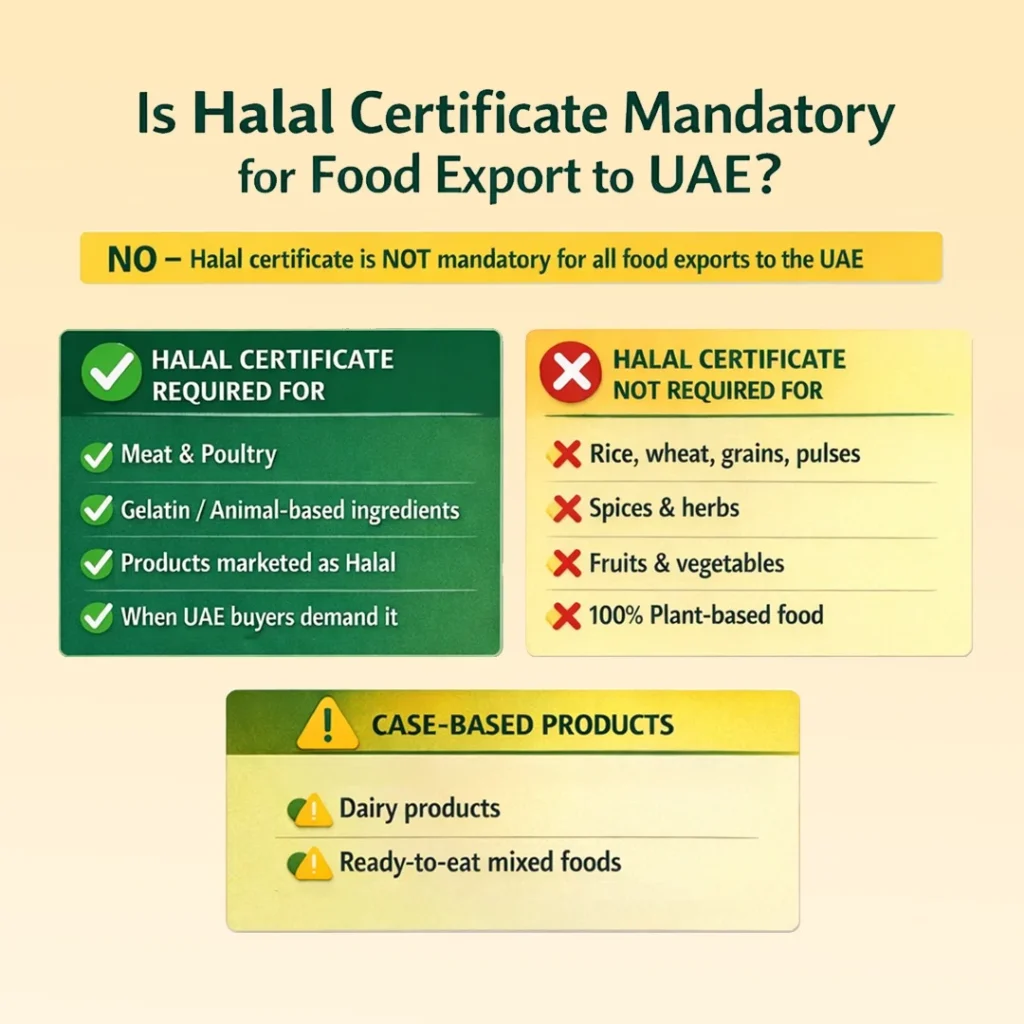
This is one of the most frequently asked and misunderstood questions in food exports. Halal certification is not mandatory for all food products exported to the UAE. The requirement depends entirely on the product category and ingredients used.
From practical import and sourcing experience, UAE authorities follow a product based compliance approach, not a blanket rule. This means each food item is assessed individually based on composition, labeling, and intended market positioning.
Halal certification is generally required when:
- The product contains meat, poultry, gelatin, or other animal based ingredients
- The product is marketed or positioned as halal food
- UAE buyers or retailers request halal certification for resale purposes
Halal certification is generally not required when:
- The product is plant based such as grains, pulses, rice, fruits, vegetables, or spices
- No animal derived ingredients are involved
- The focus is on food safety, quality, and accurate labeling
Many Indian suppliers delay or avoid shipments, assuming halal certification is compulsory for every food item. In reality, UAE food import requirements place greater emphasis on ingredient transparency, labelling accuracy, and regulatory compliance. Buyers in Dubai and across the UAE prefer suppliers who understand these distinctions, as it directly affects customs clearance, shelf placement, and consumer trust.
Understanding when halal certification is actually required helps suppliers reduce unnecessary costs and enables buyers to source products without avoidable delays.
Product Type | Halal Certificate Required | Explanation |
Fresh fruits and vegetables | No | Plant-based products with no animal ingredients |
Rice, wheat, pulses, grains | No | No halal compliance needed if ingredients are purely agricultural |
Spices and herbs | No | Accepted without a halal certificate if free from additives |
Processed vegetarian food | Usually No | Depends on ingredients, additives, and preservatives |
Dairy products | Sometimes | Required if animal enzymes or derivatives are used |
Meat and poultry products | Yes | Mandatory due to animal slaughter compliance |
Gelatin or animal-based ingredients | Yes | Source and processing must be halal-compliant |
Ready-to-eat food with mixed ingredients | Case based | Depends on ingredient composition and buyer requirements |
UAE Food Import Requirements for Indian Suppliers
For Indian suppliers, exporting food products to the UAE is less about shipment volume and more about regulatory compliance and preparation. UAE authorities focus on whether a product meets local food safety, labeling, and traceability standards before it is allowed into the market.
Key UAE food import requirements typically include:
- Accurate ingredient declaration and nutritional labeling
- Clear country of origin and manufacturer details
- Defined shelf life and storage conditions
- Approved food registration through the UAE importer
From on-ground import experience, most shipment issues arise when labeling details or documentation are misaligned. UAE importers and buyers prefer working with Indian suppliers who understand these requirements early, as it reduces clearance delays and allows faster distribution across Dubai and other UAE markets.
FAQs
Can I export food to the UAE without a halal certificate?
Yes, plant-based food products can be exported without a halal certificate if they meet UAE food safety, labelling, and import regulations.
Is halal certification mandatory for all food products in the UAE?
No, halal certification is required only for products containing animal-derived ingredients or when mandated by buyers or authorities.
Which food items do not require halal certification in the UAE?
Fresh fruits, vegetables, grains, rice, pulses, spices, herbs, and fully vegetarian processed foods generally do not require halal certification.
Is FSSAI certification enough for UAE food export?
No, FSSAI alone is not enough. UAE import rules, product registration, and labelling requirements must also be fulfilled.
Documents Required to Export Food from India to the UAE
Documentation plays a critical role in smooth food export clearance. Even high-quality products can face delays if the paperwork is incomplete, inconsistent, or unclear. For Indian suppliers exporting food products to the UAE, the focus is always on accuracy and traceability.
Common documents required to export food from India to the UAE include:
- Commercial invoice and packing list
- Certificate of origin issued by authorised Indian bodies
- Product specifications and a detailed ingredient list
- Health or quality certificate, depending on the food category
- Halal certificate only when applicable to the product
From real import operations, most clearance issues arise due to mismatches between product labels, ingredient declarations, and invoice details. UAE buyers and importers rely on clean and aligned documentation to meet local food import requirements and ensure faster customs clearance. Suppliers who prepare documents correctly from the start are more likely to build long-term, reliable trade relationships in the UAE market.
Document Name | Mandatory | Notes |
Commercial Invoice | Yes | Must match product name, quantity, and value |
Packing List | Yes | Packaging details and net weight clarity are required |
Certificate of Origin | Yes | Issued by authorised Indian bodies |
Ingredient List | Yes | Must align with product label and formulation |
Product Label Details | Yes | English or Arabic labelling as per UAE rules |
Health or Quality Certificate | Product based | Required for certain food categories |
Halal Certificate | Case based | Required only if the product contains animal ingredients |
Import Approval Registration | Yes | Done through the UAE importer registration system |
Dubai Food Import Regulations
Dubai follows strict yet practical food import regulations to ensure product safety and market suitability. Authorities focus primarily on label accuracy, ingredient transparency, shelf life, and storage conditions, rather than unnecessary certifications.
In most cases, food products with clear English labeling, accurate ingredient declarations, and compliant packaging move through clearance faster. From real import handling experience, delays usually occur when product labels do not match the declared ingredient list or when shelf life information is unclear.
Dubai buyers and retailers prefer suppliers who understand these regulations in advance, as it reduces re-verification, avoids clearance issues, and supports smoother distribution across supermarkets and retail outlets.
Food Export from India to the UAE Process
The process of exporting food products from India to the UAE is straightforward when compliance is planned early. For businesses looking to export food from India to Dubai, the focus should be on product readiness, accurate documentation, and compliant labelling.
The typical export flow includes product finalisation, preparation of export documents, labelling checks, shipment dispatch, and clearance through the UAE importer. From real import experience, food shipments with consistent ingredient details and clear shelf life information move faster, while small documentation or labelling errors cause avoidable delays. Suppliers who understand this process find it easier to scale UAE food exports into the market.
Why Indian Food Products Are in Demand in the UAE
- India exports a wide range of food products, including grains, pulses, spices, fresh produce, and processed foods
- Strong sourcing base and consistent supply support long-term Indian food exports
- Competitive pricing combined with reliable quality standards
- Familiar taste profiles that suit UAE consumers and regional markets
- Established trade flow under India exports to the UAE, making procurement easier for buyers
- Preference among supermarkets and distributors for dependable Indian suppliers
Indian Food Suppliers for the UAE Market
Indian farmers, food manufacturers, and producers see strong demand in the UAE, but many face challenges in market entry and buyer alignment. Product quality alone is not enough to succeed in this market.
UAE buyers typically expect:
- Clear understanding of UAE food import requirements
- Consistent product quality and reliable supply planning
- Accurate labelling and complete documentation
- Ability to meet supermarket and distributor standards
From practical trade experience, Indian suppliers who prepare with these expectations in mind face fewer entry barriers and are more likely to build long-term, repeat buyer relationships in the UAE market.
Conclusion
Exporting food products to the UAE is not about assumptions but about clarity. Halal certification is required for specific product categories, not for every food item. What truly matters is correct product classification, accurate documentation, and a clear understanding of the UAE market requirements.
As food trade between India and the UAE continues to grow, suppliers who prepare with compliance in mind face fewer delays, while buyers who source responsibly reduce operational and resale risks. Clear processes and market knowledge make food imports more efficient, scalable, and sustainable in the long term.
At D and S International, we work closely with Indian producers and UAE buyers to support compliant sourcing and consistent food supply across regional markets.
If you are an Indian supplier exploring opportunities in the UAE, Saudi Arabia, or Iran, or a UAE buyer looking to source reliable Indian food products, working with importers who understand both sourcing and local market expectations can simplify the process.