Most producers we speak to in India want to sell abroad. Their hesitation is rarely about the product. It is about the rules: which licence to get, which certificate the buyer will ask for, and what the government allows this year that it didn’t last year.
The export import policy of India sounds heavy, but a first-time exporter needs only a few parts of it. This guide covers those parts in plain words: the Foreign Trade Policy 2023, how your product is classified, the export documentation you will handle, the schemes worth knowing, and how import duties work on the other side of a deal.
What Is the Export Import Policy of India?
India’s foreign trade runs under the Foreign Trade (Development and Regulation) Act, 1992. Under that Act, the Directorate General of Foreign Trade (DGFT), part of the Ministry of Commerce and Industry, issues the Foreign Trade Policy, or FTP. Many traders still call it the “EXIM policy”, its older name. Both terms mean the same thing.
The current version, FTP 2023, was announced on 31 March 2023 and replaced FTP 2015-20. Unlike earlier policies, it has no fixed end date. DGFT changes it through notifications and public notices whenever needed. Its stated goal is to take India’s total exports to about $2 trillion by 2030.
For a producer, this matters for one reason: the policy is a living document. A rule you read about last season may have changed since, so check the current position on the DGFT website before you quote a price to a buyer.
How the Export Policy of India Classifies Your Product
Every product has an ITC(HS) code. This is an eight-digit number based on the international Harmonized System. Against each code, the export policy of India places the product in one of four categories.
| Category | What it means | What you need |
| Free | Can be exported without special permission | IEC and normal export documentation |
| Restricted | Allowed only with an authorisation, or under conditions such as a minimum export price | A DGFT authorisation or proof that the conditions are met |
| Prohibited | Cannot be exported | Not applicable |
| STE | Can be exported only through a notified State Trading Enterprise | Export routed through that agency |
Farm products move between these categories more often than most goods. Onion and rice have both faced export bans, minimum export prices or export duties in recent years while the government managed prices at home. So the first job in any export plan is simple: look up your product’s current ITC(HS) status and any recent notification on it.
Getting Started: IEC, RCMC and Product Registrations
Before your first shipment, you need a few registrations. None of them is difficult, but each one has to be in place before the goods move.
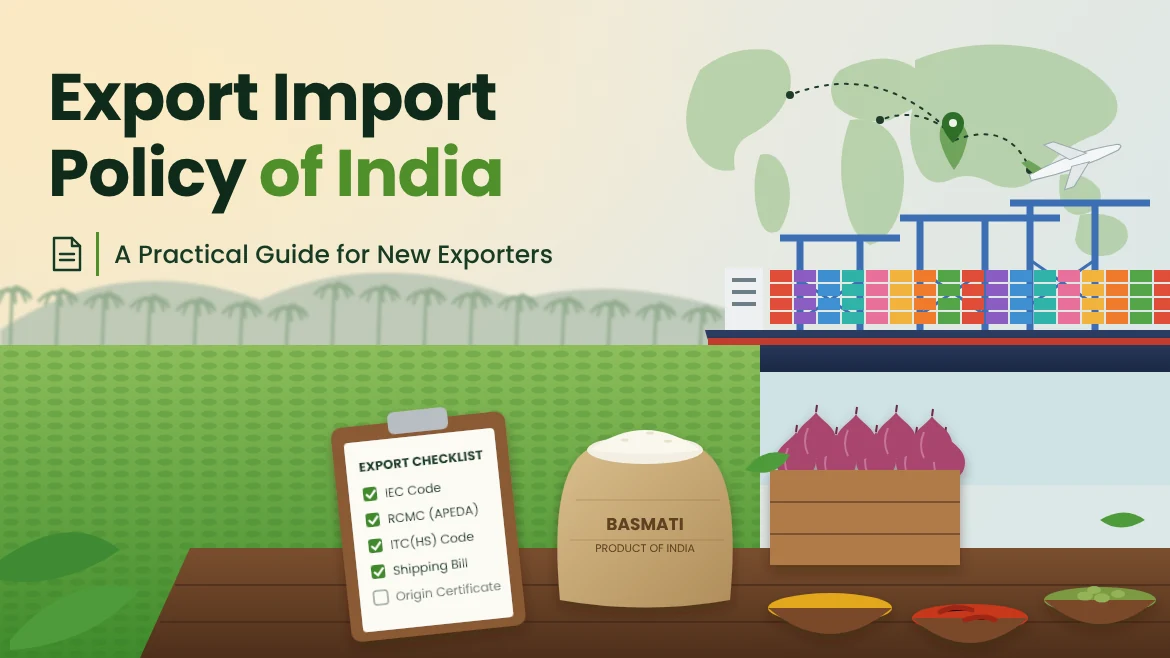
- Importer Exporter Code (IEC). This is a 10-digit code issued online by DGFT and linked to your PAN. You need it for almost every export and import. You also have to update it online every year between April and June, or it gets deactivated.
- RCMC. The Registration-cum-Membership Certificate comes from the export promotion council for your product. For most farm and processed food products that is APEDA. For spices it is the Spices Board. You need an RCMC to claim most scheme benefits.
- Product-specific approvals. Food exporters need an FSSAI licence. Fresh produce, grains and spices need a phytosanitary certificate from the plant quarantine authority. Organic produce needs certification under NPOP.
- GST and LUT. With GST registration and a Letter of Undertaking, you can export without paying IGST upfront.
Farmer groups and FPOs follow the same route, with the registration in the FPO’s name. We covered this in detail in our earlier posts on the D&S International blog.
Export Documentation You Will Handle
Export documentation is where most first shipments get delayed. The set for a typical food consignment looks like this:
- Commercial invoice: the price, terms and buyer details.
- Packing list: the number of bags or cartons, net and gross weight, and the marks on each package.
- Shipping bill: filed electronically with Customs on ICEGATE, usually through your customs broker.
- Bill of lading or airway bill: issued by the shipping line or airline once the goods are loaded.
- Certificate of origin: proves the goods are Indian. Under a trade agreement, such as the India-UAE CEPA in force since May 2022, it lets your buyer claim lower or zero import duty.
- Phytosanitary certificate and lab reports: these confirm the goods are free of pests and within residue limits.
- Insurance certificate: needed when you sell on CIF terms.
One practical tip: make sure the invoice, packing list and shipping bill match exactly. If the weight, product description or HS code differs between them, the goods can be held at port. That is the most common avoidable delay we see. At D&S International, checking these papers before dispatch is a standard part of how we work with our suppliers.
Export Promotion Schemes Worth Knowing
The FTP is not only about rules. It also offers export promotion schemes that lower your costs. These are the ones a farm or food exporter is most likely to use:
- RoDTEP (Remission of Duties and Taxes on Export Products): refunds taxes built into your costs that are not refunded any other way, such as duty on fuel. It is paid as an electronic scrip, and the rate depends on the product.
- Advance Authorisation: lets you import inputs duty-free when they are used to make export goods.
- EPCG (Export Promotion Capital Goods): lets you import machinery such as sorting, grading or packing lines at zero duty. In return you must meet an export obligation, typically six times the duty saved within six years.
- Districts as Export Hubs: each district prepares an export action plan for its key products. If your crop is on your district’s list, you may get local support and training.
- Status holder recognition: FTP 2023 lowered the export thresholds. One Star needs $3 million in exports and Two Star now needs $15 million. Status holders get faster clearances and other benefits.
The policy also raised the value limit for exports by courier from ₹5 lakh to ₹10 lakh per consignment. That helps small producers sending samples or e-commerce orders.
Import Duties and Import Licensing: The Other Side of the Trade
The export import policy covers imports too. Most goods are “free” to import, but some need import licensing or meet conditions before they can enter India. When an import does come in, the bill is usually built from three parts: Basic Customs Duty, the Social Welfare Surcharge charged on that duty, and IGST.
Why should an exporter care about import duties? There are two reasons. First, if you bring in packaging or machinery, these duties hit your costs, unless a scheme like Advance Authorisation or EPCG covers them. Second, your buyer pays import duty in their own country. Under the CEPA, many Indian food products enter the UAE at reduced or zero duty, which makes your price more competitive than a supplier from a country without such an agreement.
Trade Compliance Mistakes First-Time Exporters Make
Good trade compliance is mostly about habits. These are the mistakes we see most often:
- Quoting a buyer before checking the product’s current export status.
- Letting the IEC lapse by missing the yearly update.
- Using a different HS code on the invoice than on the shipping bill.
- Skipping pesticide residue testing, then facing a rejection at the destination port.
- Not asking for a certificate of origin, so the buyer loses a duty benefit they expected.
- Not tracking payment receipt. Export proceeds must be brought back to India within the time RBI allows.
Final Thoughts
The export import policy of India is not something to memorise. Learn where to check it and which parts apply to your product. Get your IEC and RCMC in place, keep your documents consistent, and check the DGFT notifications before every season. Get those basics right and most of the rules take care of themselves.
If you grow or trade spices, rice, grains, pulses or fresh produce and want a dependable buyer in the Gulf, talk to the D&S International team. We source from Indian producers and supply buyers in the UAE, Saudi Arabia and beyond, and we handle the paperwork with you, step by step.