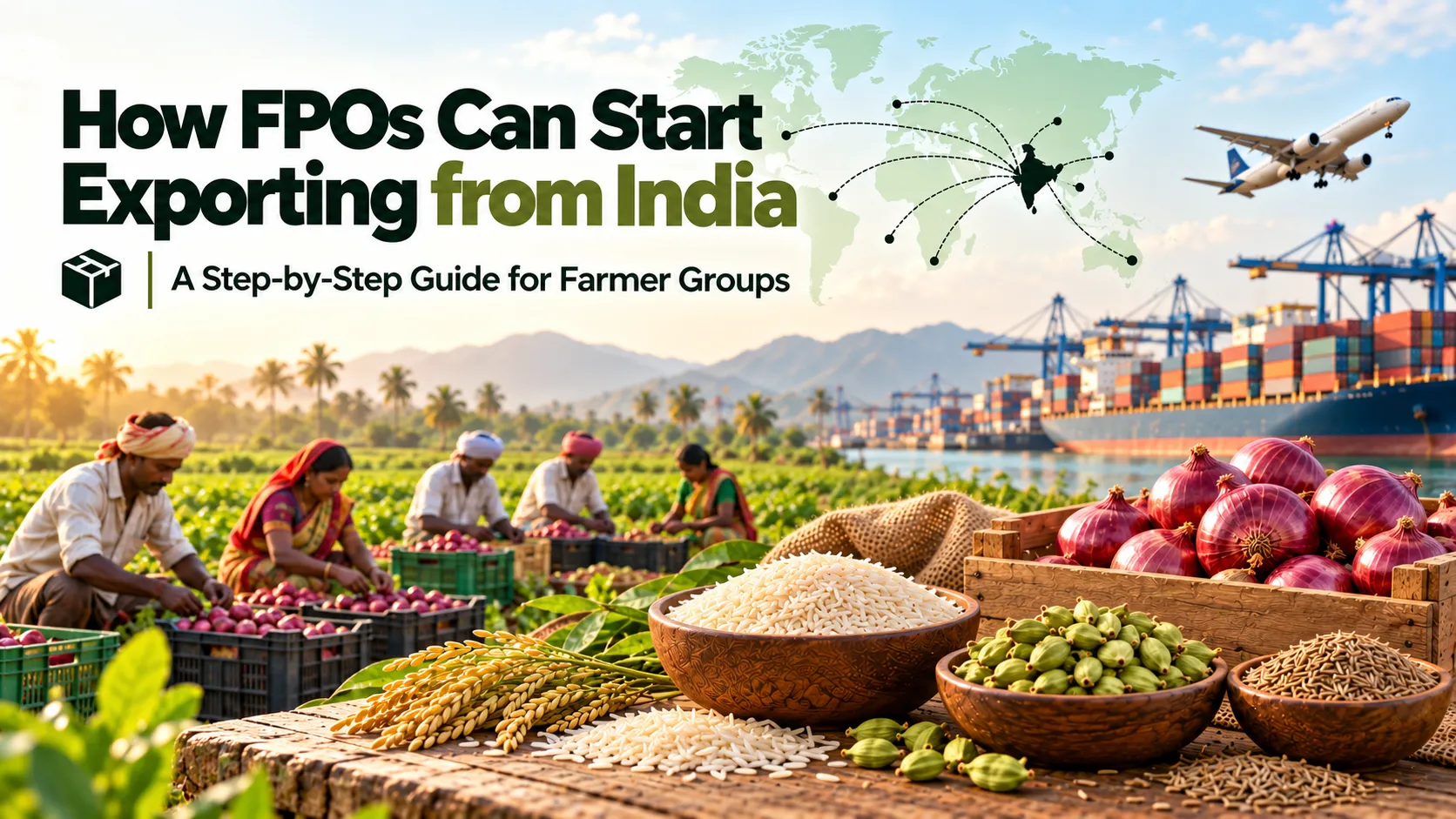
Yes, a Farmer Producer Organisation (FPO) can export directly from India. It needs an Import Export Code (IEC), a registration with APEDA or the Spices Board, an FSSAI licence, and a confirmed overseas buyer.
Most farmer groups already have the hard part, which is good produce in large quantity. What they usually miss is the paperwork, the buyer, and a clear idea of what the buyer checks before paying. This guide explains all three in simple steps, so your FPO can plan its first shipment with confidence.
Can an FPO export directly from India?
An FPO is a registered business owned by its farmer members, usually a producer company or a cooperative. Because it is a legal entity, it can hold an IEC and sell to a foreign buyer in its own name.
This is already happening. On 1 October 2026, Aterna Foods Producer Company Limited from Sonipat, Haryana shipped 24 tonnes of frozen food to Canada with support from APEDA. In 2024-25, APEDA helped flag off 9 export shipments from FPOs in 7 states, as per a reply in the Lok Sabha.
India now has 10,000 FPOs formed under the central scheme, with a combined turnover of ₹20,358 crore as of 31 July 2026. For most of them, export is still a new area, so the scope is wide.
Two ways an FPO can export
An FPO can sell to a merchant exporter in India, or it can export in its own name. Both are valid. The right choice depends on how ready your group is.
| Point | Through a merchant exporter | Direct export by the FPO |
|---|---|---|
| Exporter on paper | The merchant exporter | The FPO |
| Registrations | Normal business papers | IEC, RCMC and FSSAI |
| Who finds the buyer | The exporter | The FPO |
| Payment | In rupees, from the exporter | In foreign currency, from the overseas buyer |
| Margin | Lower | Higher |
| Risk and effort | Low | Higher |
| Best for | The first one or two seasons | FPOs with steady quality and volume |
Many groups start with the first route, learn what buyers ask for, and then move to direct export.
How can an FPO start exporting? 7 steps
Step 1: Pick one product and one market
Start with the crop your members grow best and in the largest quantity. Then check which country buys it regularly. Gulf countries, for example, buy Indian rice, onion, cardamom and cumin through the year. One product and one country is enough for the first season.
Step 2: Get the basic registrations
Your FPO needs these in its own name:
- IEC: apply online on the DGFT website using the FPO’s PAN.
- RCMC from APEDA: needed for fruits, vegetables, rice and other cereals. You apply on the DGFT portal after getting the IEC. The fee is ₹5,900 including GST and the certificate is valid for 5 years, as per the APEDA registration circular.
- Spices Board registration: needed in place of APEDA if you export spices such as cardamom or cumin.
- FSSAI licence: required for any food business.
- Bank account for foreign trade: your bank will give an AD code, which customs needs.
Our guide on APEDA, FSSAI and IEC registration explains each one in detail.
Step 3: Fix quality at the farm level
Buyers reject shipments for high pesticide residue, excess moisture, mixed sizes and foreign matter. An FPO can control all four because it works directly with farmers. Agree on one variety, a common spray schedule and a harvest window. Keep a simple record of which farmer supplied which lot.
Step 4: Collect, grade and pack
Export buyers usually order by the container, so plan your collection around one full container load. Sort and grade the produce at a clean pack house. Use the packing the buyer asks for, not what the local mandi uses.
Step 5: Find a genuine buyer
Good places to meet buyers are APEDA buyer-seller meets, food fairs such as AAHAR, Indusfood and Gulfood, and importing companies in your target market. Before you agree to anything, check the buyer’s trade licence, website and past trade. Start with a small trial order.
Step 6: Agree on price and payment in writing
Your price should cover produce cost, grading, packing, transport to port, port charges and your margin. Most first deals are on FOB terms, where your job ends once the goods are loaded on the ship. For payment, ask for an advance or a letter of credit. Avoid open credit with a new buyer.
Step 7: Prepare documents and ship
A customs house agent will file the shipping bill for you. Keep these ready:
- Commercial invoice and packing list
- Phytosanitary certificate
- Certificate of origin
- Lab test report, and a fumigation certificate if the buyer needs it
- Bill of lading from the shipping line
What government support can FPOs use?
Several government schemes help FPOs that want to export. The main ones are:
- 10,000 FPO scheme: up to ₹18 lakh for management costs in the first three years, a matching equity grant of up to ₹15 lakh, and a credit guarantee on project loans of up to ₹2 crore, as per the government’s August 2026 update.
- APEDA Financial Assistance Scheme: covers export infrastructure, quality development and market development.
- Trade fairs at lower cost: APEDA took 12 organic FPOs from 6 states to BIOFACH 2026 in Germany.
- Training: APEDA ran 764 export training programmes in 2025-26 (up to March 2026), with FPOs given priority.
- Certification help: 7 FPOs received financial help to get GlobalG.A.P. certification.
The fair, training and certification figures are from the Lok Sabha reply of 17 March 2026. Your nearest APEDA regional office can tell you what your FPO qualifies for.
Common mistakes first-time FPO exporters make
Most first shipments fail for simple reasons, not big ones. Watch for these:
- Promising a volume that members cannot supply on time
- Mixing varieties or grades in one lot
- Skipping the lab test before the goods leave the pack house
- Shipping on credit to a buyer nobody has checked
- Quoting a price without adding packing, transport and port costs
- Starting with too many products at once
How D&S International works with FPOs
D&S International is a Dubai-based food import and export company. We buy Indian spices, rice and fresh produce and supply them to buyers in the UAE, Saudi Arabia and other markets.
For an FPO, this means a known buyer on the other side, along with guidance on documentation, HS codes, quality checks and packing. If your group grows cardamom, rice, onion or cumin, send us your product, grade and monthly volume. Our team will tell you what our buyers need and how to prepare for it.
Contact D&S International to discuss your first shipment.
FAQ's
Yes. An FPO registered as a producer company or cooperative can export in its own name once it has an IEC, the right export body registration and an FSSAI licence.
An FPO needs an IEC from DGFT, an RCMC from APEDA (or Spices Board registration for spices), an FSSAI licence and a bank account with an AD code.
APEDA registration costs ₹5,900 including GST. It is valid for 5 years and renewal costs the same.
Yes. It can sell to a merchant exporter, who ships the goods under their own IEC. The FPO is paid in rupees and carries less risk.
Products with a long shelf life, such as rice, cumin and cardamom, are easier to start with than fresh produce. Onion and other fresh items need faster handling and better packing.