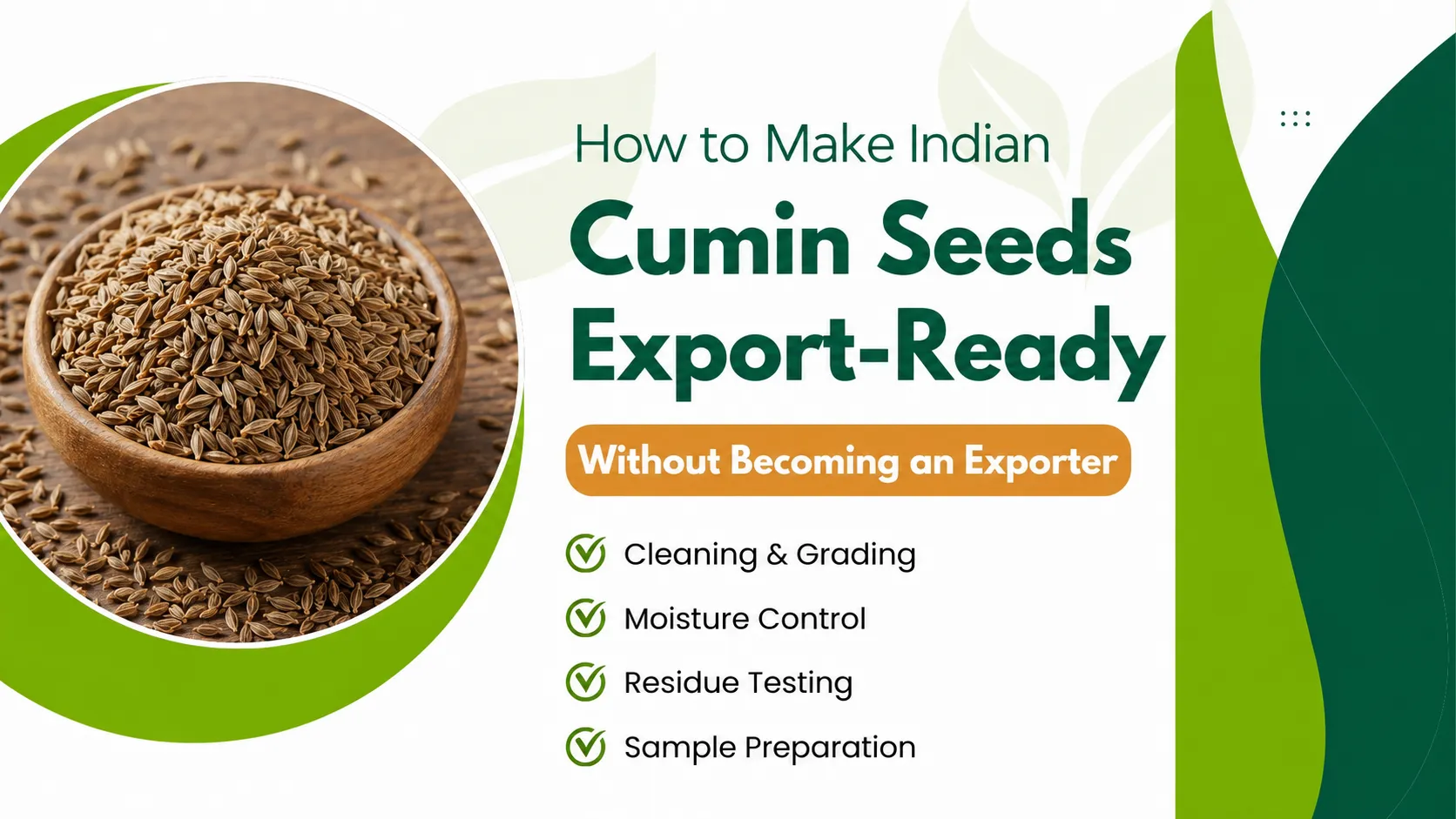
India has one of the world’s strongest cumin supply chains, supported by large production clusters, processing facilities and an established spice-export ecosystem. For Indian farmers, processors and bulk cumin suppliers, this creates an opportunity to supply international markets without necessarily building an export company from scratch.
In 2025–26, cumin accounted for around 12% of India’s total spice-export earnings, making it one of the most valuable products in the country’s spice-export basket.
However, producing good jeera and preparing cumin that an international buyer can confidently approve are not the same thing.
For producers looking to enter the cumin export supply chain, the practical priority is to make the product easy to evaluate, test, source and supply consistently.
Export Opportunity for Indian Cumin Producers
India’s cumin production is concentrated largely in Rajasthan and Gujarat. The latest Spices Board figures continue to show these two states dominating cumin production in India, with Rajasthan currently producing more cumin than Gujarat.
Large production alone does not guarantee export acceptance.
International buyers and exporters purchase according to specifications. The value of a commercial lot can depend on its cleanliness, crop year, moisture, purity, residue status, processing method, aroma and consistency.
This is why Indian cumin seeds manufacturers, farmers and traders should prepare the product for the buyer before focusing on the shipment.
D&S already provides a detailed guide to the full cumin export process from India. This guide focuses instead on preparing the supplier and product for that supply chain.
1. Identify the Cumin Lot Clearly
A professional bulk offer should communicate more than “good-quality cumin available.”
Every commercial lot should have basic information such as:
| Supplier information | Example |
|---|---|
| Product | Whole Cumin Seeds |
| Origin | Rajasthan, India |
| Crop | Current crop |
| Processing | Machine cleaned |
| Available stock | 10 MT |
| Monthly capacity | 20 MT |
| Packing | 25 kg / 50 kg |
| Sample | Available |
| Lab report | Available / pending |
This information helps an exporter or sourcing company quickly determine whether the stock matches an existing requirement.
For a cumin seed manufacturer, additional details such as machine-cleaned, Sortex-cleaned, steam-treated or other processing capabilities should be stated clearly.
Avoid advertising specifications that have not actually been measured.
2. Focus on Clean Drying and Processing
Post-harvest handling has a direct effect on export-market suitability.
The Spices Board’s official quality guidance for cumin recommends drying the crop on clean surfaces, protecting it from rain and avoiding artificial colouring. It also emphasizes proper storage and protection against moisture and contamination.
For producers, the commercial objective is simple:
clean product + consistent lot + repeatable quality
Poorly cleaned jeera seeds, visible foreign matter or mixed-quality lots may reduce buyer confidence even when the underlying crop is good.
A supplier should also avoid creating a carefully selected premium sample that does not represent the actual material available for bulk supply.
The approved sample and final commercial lot should remain reasonably consistent.
3. Understand Machine-Cleaned and Sortex Cumin
Export buyers often discuss cumin according to processing and cleaning level.
Machine-cleaned cumin typically goes through mechanical processes that remove dust, foreign material and undesirable matter.
Sortex-cleaned cumin adds optical sorting that can further remove discoloured or visually defective seeds.
Neither option is automatically right for every buyer.
Current commercial sourcing guides commonly differentiate cumin according to purity, moisture, volatile oil and processing level, while the exact specification varies by destination and end use.
Indian cumin suppliers should therefore avoid paying for additional processing before understanding the buyer requirement.
The better sequence is:
buyer specification → processing requirement → sample approval → commercial supply
D&S’s broader spices sourcing and export category includes cumin seeds alongside other Indian spices supplied to international markets.
4. Treat Pesticide Residues as a Buyer Requirement
Appearance alone cannot confirm that cumin is suitable for an overseas market.
The Spices Board specifically states that importing countries check cumin for pesticide residues and advises that pesticides banned in importing markets should not be used on the crop. Spices Board quality guidance for cumin
For producers interested in the cumin export supply chain, good record keeping becomes important.
Maintain information covering:
- Farm or sourcing origin
- Crop year
- Crop-protection practices where available
- Processing location
- Lot identification
- Test reports linked to the correct lot
Destination requirements may differ. A specification accepted by one buyer should not automatically be assumed to satisfy another.
The Spices Board also publishes current trade advisories and compliance notifications for spice exports. View Spices Board trade notifications
5. Prepare a Representative Buyer Sample
A good sample should represent what the supplier can actually deliver.
The sample should ideally be identified with:
Product name | Origin | Crop | Processing method | Lot number | Available quantity
Recent product photographs and videos can also help the sourcing team conduct an initial assessment before physical sampling.
For larger cumin seeds manufacturers in India, a buyer may additionally request a Certificate of Analysis or laboratory results covering parameters relevant to that particular order.
A report should correspond to the same lot or product being offered wherever possible.
6. State Real Supply Capacity
International sourcing depends on dependable volume.
A message such as:
“10 MT of machine-cleaned whole cumin seeds currently available in Jodhpur, with approximately 20 MT monthly capacity”
is commercially more useful than:
“Jeera available. Buyer required.”
Producers should prepare four numbers before approaching a sourcing partner:
current stock | minimum supply quantity | monthly capacity | expected future availability
FPOs and aggregators should also mention whether their supply is consolidated from several farms or comes from a single production cluster.
This makes it easier for an exporter to assess whether the supplier can support a trial order, container programme or repeat requirement.
7. Do Not Compete Only on Cumin Seeds Price
The lowest cumin seeds price does not automatically create the best export opportunity.
Bulk buyers may compare suppliers on:
- Product consistency
- Purity
- Processing
- Residue compliance
- Reliable quantity
- Sample-to-shipment consistency
- Packing
- Documentation support
- Delivery reliability
A slightly higher-priced supplier capable of reproducing the same specification every month may be more commercially useful than a cheaper supplier whose quality changes from lot to lot.
For producers trying to build a sustainable export-oriented cumin business, repeatability should be treated as part of the product.
8. Enter the Export Supply Chain Without Managing Everything Yourself
A producer or domestic supplier does not necessarily need to perform every international trade function.
An entity that actually operates as a spice exporter must follow the applicable exporter-registration requirements, including the Spices Board’s Certificate of Registration as Exporter of Spices (CRES) process. View official CRES information
A producer supplying through an established export partner can instead focus on:
production → processing → quality → sample → quantity → reliable supply
while the appropriate exporting entity manages functions such as international documentation, buyer coordination, customs and shipment requirements.
D&S International states that it sources agricultural products directly from manufacturers, farmers and traders and manages product verification, quality checks, documentation and international supply coordination. Learn more about D&S International
Producers who want to understand the wider process can also read D&S’s guide on how to export spices from India.
Preparing Cumin for a Serious Supply Enquiry
Before approaching an export or sourcing partner, keep the following information ready:
- Supplier type — farmer, FPO, manufacturer, processor or trader
- Location
- Cumin origin
- Crop year
- Whole cumin or processed form
- Machine-cleaned or Sortex-cleaned
- Current available quantity
- Monthly supply capacity
- Product photographs
- Representative sample availability
- Laboratory report or COA, if available
- Packing capability
This information allows the sourcing team to evaluate the opportunity faster and reduces unnecessary back-and-forth.
Supply Indian Cumin Seeds Through D&S International
D&S International works with farmers, manufacturers and traders to source agricultural products for buyers in the UAE, Saudi Arabia, Iran and other international markets.
Indian producers and bulk suppliers with whole cumin seeds available in commercial quantities can share their stock for sourcing consideration.
Share Your Cumin Supply Details
Connect with D&S International to explore suitable international-market requirements and supply opportunities.