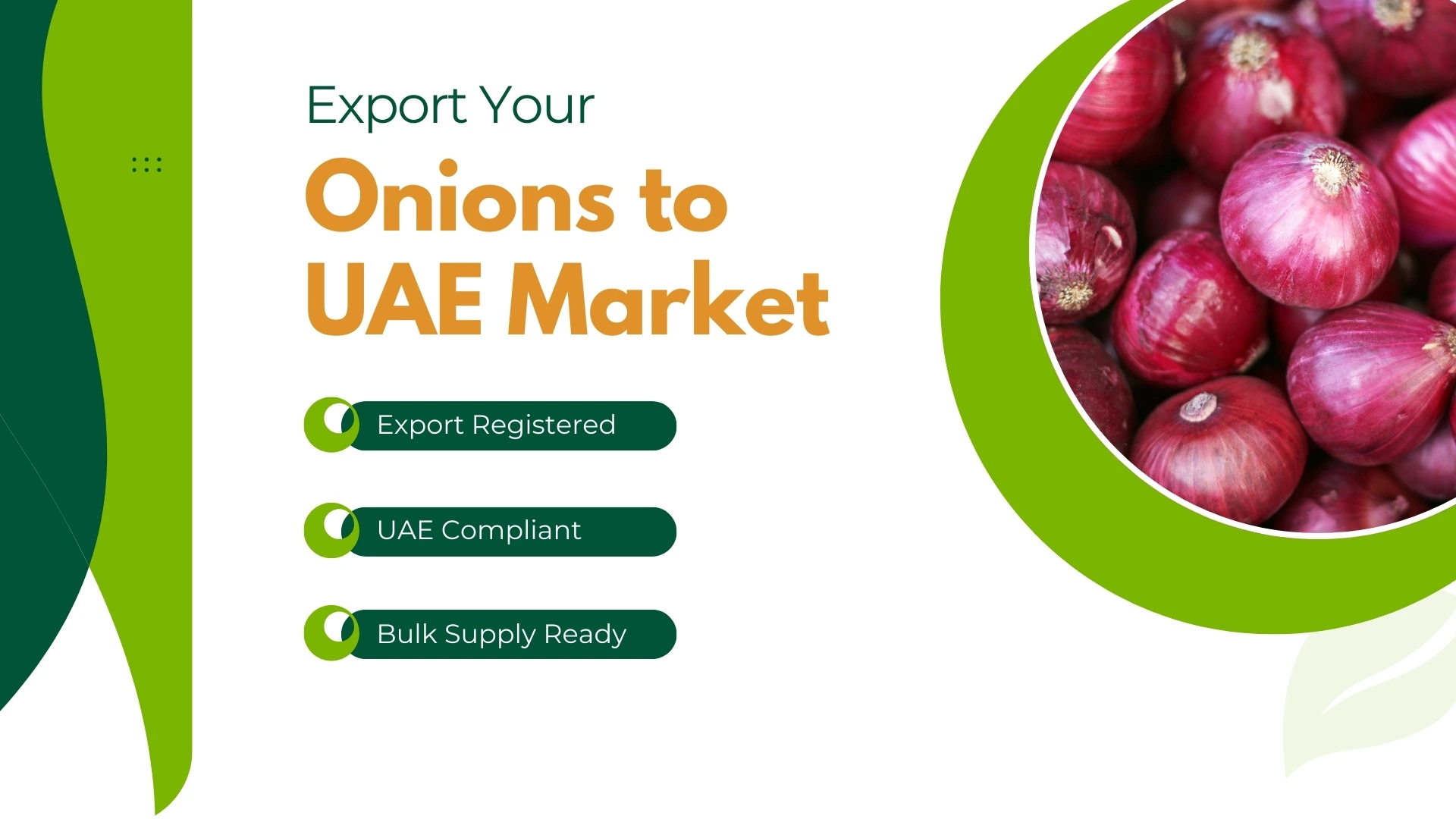
Onion is one of the common vegetables used for the preparation of almost every cuisine. This makes it a highly demanded product globally. This global demand gives a great opportunity for suppliers to export their yield.
One of the major agricultural exporters that supplies the maximum produce of red and white onions is India. A rough number of 403,000 MT of onions was exported in 2025. This huge export number was achieved due to the Indian government’s announcement to reduce 20% onion export duty. Thus, allowing Indian suppliers to explore the global market.
Though India has suitable temperature and weather conditions and produces the best quality onions, many suppliers do not know how to begin their export journey. This blog will guide exporters on how to reach reliable buyers in the UAE and everything else involved in the process.
India-UAE Agricultural Trade Context
The UAE is a popular tourist spot in the world with top technology and infrastructure. However, it depends heavily on food imports from other countries, one of them being India.
This is because:
- It has very little farmland.
- The climate is very hot and dry.
- Water is limited.
- The population is growing fast.
India, on the other hand, exports food products to UAE, like rice, spices, fruits, vegetables, and pulses. This is possible because India has:
- Large farming land
- Different climate zones
- Skilled farmers
- Strong agricultural production
Over the years, trade agreements and better shipping systems have made it easier to transport goods quickly between the two countries. This strong connection makes onion export an important business opportunity.
FAQs
How to export onions from India to Dubai?
Exporting onions to Dubai requires an Indian supplier to get an IEC, Phytosanitary Certificate, follow FSSAI rules, complete APEDA registration, and export documentation.
Top 10 onion exporters in India
- D and S International
- Maharashtra State Agricultural Marketing Board (MSAMB)
- National Cooperative Consumers’ Federation of India Ltd (NCCF)
- National Agricultural Cooperative Marketing Federation of India Ltd (NAFED)
- Gujarat Agro Industries Corporation Ltd
- Mother Agri Cold Storage Pvt Ltd
- Sri Vyshnavi Exports
- Gurucharanam Agriculture Producer Company Ltd
- National Spot Exchange Ltd
- Rajdeep Exporters
Which onion varieties are best for the Dubai market?
Red onions from Nashik, Maharashtra, India, are usually the most demanded onions in Dubai. Apart from that, other varieties preferred are rose and garva onions.
What is the price of onion export from India to Dubai?
As of late 2025 to early 2026, the price of Nashik red onions for export to Dubai ranges between ₹15.50 and ₹18.60 per kg (approx. $0.18–$0.22 USD), while the landing price in Dubai has been reported at up to 2.50 AED per kg (around $0.68 USD).
What can I export from India to the UAE?
One can export many goods to the UAE, including agricultural products (spices, grains, and pulses), jewelry, textiles, medicines, and more.
Overview of Indian Onion Production
India is the second-largest onion producer in the world, with production fluctuating due to weather conditions. Many states in India produce onions, such as:
- Maharashtra
- Karnataka
- Madhya Pradesh
- Gujarat
- Rajasthan
Among these states, Maharashtra is famous for its huge onion production. Let’s understand the production cycle to know why India is an in-demand onion supplier.
Three Main Onion Seasons in India
- Kharif Crop: Harvested around October to December
- Late Kharif Crop: Harvested around January to March
- Rabi Crop: Harvested around March to May
The Rabi crop is the most important for export. It is known as the season of bumper harvest, yielding the best quality of onions. Moreover, Rabi onions are famous because they:
- Have lower moisture
- Have a stronger outer skin
- Last longer in storage
- Are less likely to rot
These qualities make them better for long-distance shipping to the UAE.
India grows different types of onions:
- Red onions (most popular for export)
- White onions
- Pink onions
Red onions are commonly exported to the UAE because they are strong in flavor and have a good shelf life.
Why the UAE Market Prefers Indian Onions
The UAE imports onions from different countries, but Indian onions are often preferred. Let us understand why.
1. Good Quality
Indian onions are known for their strong taste and long shelf life. They remain fresh even after being exported from different mediums.
2. Competitive Price
India produces onions in large quantities. This helps keep prices competitive compared to some other countries.
3. Regular Supply
India’s three growing seasons make onions available almost all the time. Thus, giving the UAE access to fresh produce throughout the year.
4. Suitable Size and Variety
Indian farmers sort onions into different sizes. UAE markets prefer medium to large-sized onions, which are easily available from India.
5. Fast Shipping
Dubai onion import doesn’t take much time. This easy accessibility and short distance reduce the risk of onions getting bad, and reach buyers in time.
Because of these reasons, Indian onions have built a strong presence in the UAE wholesale markets.
Export Regulations & Compliance Requirements for Onion Export from India
Exporting onions is an easy process if all the regulations and compliance requirements are followed accurately. When a supplier follows the rules, they become a trusted source for buyers.
Here is the list of regulations one must follow:
A. Requirements in India
Before exporting, a producer must:
- Get an Import Export Code (IEC)
This is like a license to do international trade. - Register with APEDA
The APEDA supports agricultural exports and provides guidelines. - Obtain a Phytosanitary Certificate
This certificate confirms that the onions are free from harmful pests and diseases. - Follow FSSAI Rules
Food safety standards must be followed to ensure the onions are safe to eat. - Complete Export Documentation
This includes the invoice, packing list, shipping bill, and other customs documents.
B. Requirements in the UAE
The importer in the UAE must:
Have a valid trade license
Follow food safety rules
Register the product if required
Clear customs inspection
Following all rules carefully is important. If documents are missing, the shipment may be delayed or rejected.
Export Regulations & Compliance Requirements for Onion Export from India
| In India | In UAE |
|---|---|
|
Get an Import Export Code (IEC) |
Have a valid trade license |
|
Complete APEDA Registration |
Follow food safety rules |
|
Obtain a Phytosanitary Certificate |
Register the product if required
|
|
Follow FSSAI Rules
|
Clear customs inspection
|
How Onion Manufacturers in India Can Start Exporting to the UAE
To help you begin your export business smoothly and in an informed manner, here is a step-by-step guide you can follow:
Step 1: Get Necessary Registrations
Apply for IEC and register with APEDA.
Step 2: Study the Market
Understand what size, variety, and quantity the UAE market needs.
Step 3: Prepare the Crop
Select good-quality onions, especially from Rabi crops, if possible.
Step 4: Sorting and Grading
Remove damaged onions and sort according to size.
Step 5: Packaging
Pack onions in proper mesh bags with labeling details.
Step 6: Finalize Price and Agreement
Agree on price, payment terms, and delivery conditions.
Step 7: Documentation
Prepare invoice, packing list, shipping documents, and phytosanitary certificate.
Step 8: Customs Clearance
Clear Indian customs and load the shipment onto the vessel.
Step 9: Shipping
The shipment is arranged through appropriate international logistics services and delivered to the UAE.
Step 10: Payment Settlement
Payment is made as per agreed terms (advance, Letter of Credit, etc.).
Quality Standards & Packaging for the UAE Market
Quality is essential in the export business. Onion buyers in Dubai are very particular about the quality and packaging of products being exported. To help you understand their expectations, here is a list of things you must know:
A. Size Grading
Small
Medium
Large
Buyers often specify the size they want.
B. Moisture Control
Onions must be properly dried (cured) before packing. Too much moisture can cause rotting during shipping.
C. No Sprouting or Damage
Onions with cuts, fungus, or sprouting are usually rejected.
D. Packaging
Common packaging types include:
- Mesh bags (usually 5 kg, 10 kg, or 25 kg)
- Net bags
- Sometimes cartons
Good packaging should:
- Allow air circulation
- Protect onions from damage
- Be strong enough for stacking
E. Container Loading
Onions are loaded carefully into containers. Sometimes dry containers are used. In certain cases, temperature-controlled containers (reefers) may be used. This is because proper loading reduces damage during travel.
| Category | What Should Be Done | Why It Is Important | What Can Go Wrong |
|---|---|---|---|
|
Size Sorting |
Sort onions into Small, Medium, and Large sizes
|
Buyers want onions in the same size
|
The buyer may refuse or lower the price
|
|
Drying (Moisture Control) |
Dry the onions properly before packing |
Wet onions can rot easily
|
Onions may spoil during travel
|
|
Good Condition |
Remove onions that are cut, rotten, or sprouting
|
Remove onions that are cut, rotten, or sprouting
Only healthy onions should be sent
|
Shipment may be rejected
|
|
Outer Skin |
Keep the dry outer skin safe and clean
|
It protects the onion inside
|
Onions may spoil faster
|
|
Packing Type |
Use mesh or net bags that let air pass
|
Air keeps onions fresh
|
Onions may get crushed or wet
|
|
Strong Bags |
Use strong bags for packing
|
Bags should not tear
|
Onions may fall or get damaged
|
|
Labeling |
Write the weight and origin clearly on the bag
|
Helps in checking and delivery
|
Delay at customs
|
|
Loading Carefully |
Stack and place bags properly
|
Prevents damage during travel
|
More spoilage and loss
|
Common Challenges in Onion Export
Exporting onions is profitable, but it also has certain challenges. Let’s understand them in brief, so that you can be prepared in advance:
1. Price Fluctuation
Prices in the Indian onion market can change quickly due to weather changes or supply shortages.
2. Government Policies
Sometimes the government may put export restrictions to control local prices.
3. Quality Rejection
If onions are damaged or not graded properly, buyers may reject the shipment.
4. Storage Loss
Improper storage before shipment can lead to rotting.
5. Payment Risk
In international trade, delayed payment can create financial stress.
6. Transport Delays
Shipping delays may reduce shelf life
Conclusion
Onion products are essentials imported by UAE. This export demand creates healthy trade relations between India and the UAE. This agricultural trade is possible because India produces large quantities of onions in different seasons, especially the Rabi crop, which is highly demanded for export.
However, to export onions, producers must follow proper rules, maintain quality standards, complete documentation, and manage logistics carefully. Moreover, there are several challenges, such as price changes, policy shifts, and quality risks, that you should be aware of. But with proper planning and knowledge, these challenges can be managed.
As trade relations between India and the UAE continue to grow, onion export is likely to remain an important and promising opportunity in the agricultural sector. D and S International collaborates with trusted Indian onion traders so that the best yield from the country reaches the UAE. If you want to begin your export business, contact us.